
Environmental Impact of Home Rooftop Solar in India: What the Numbers Actually Show
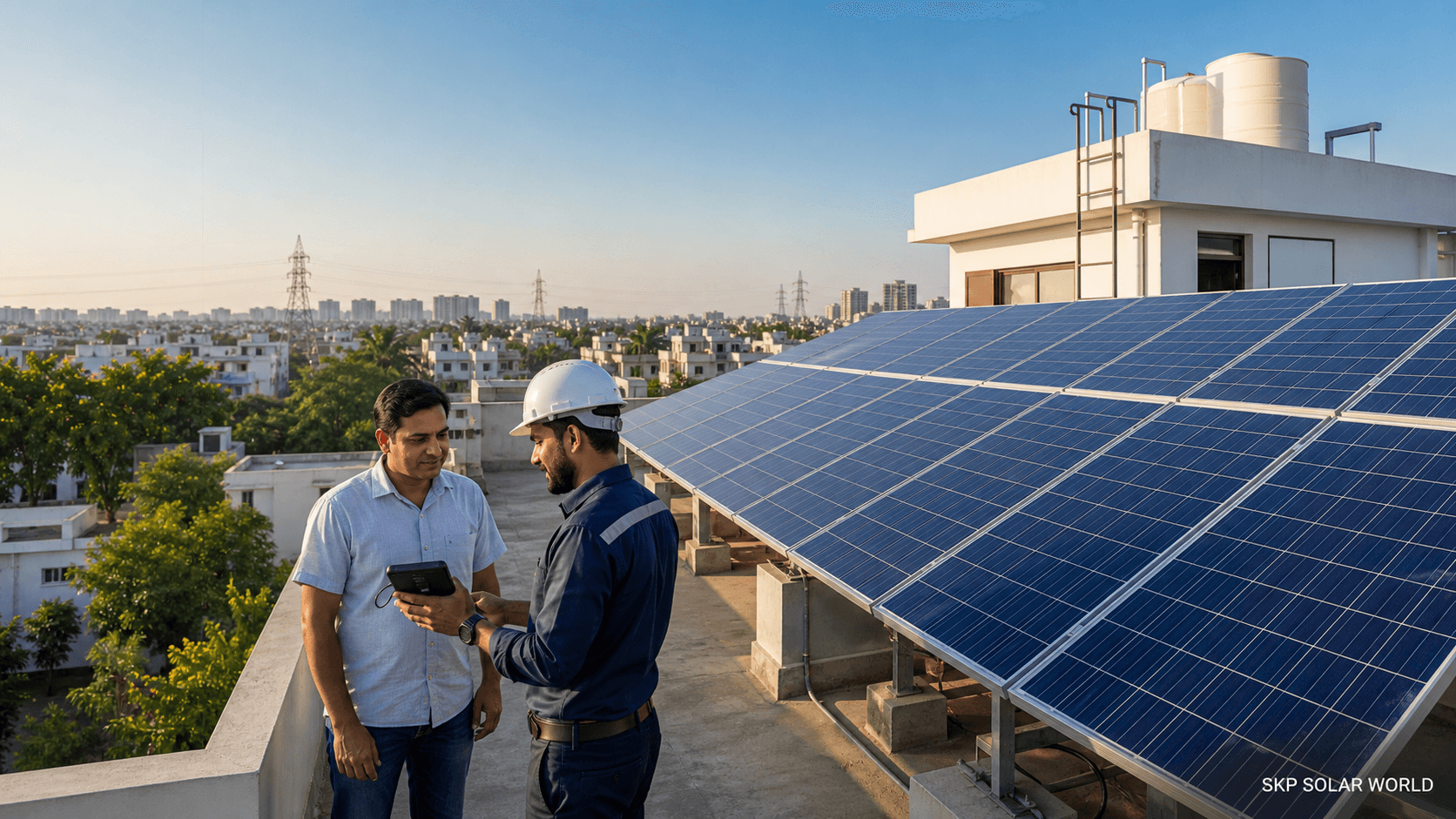
A home rooftop solar system in India offsets grid electricity almost kilogram for kilogram in avoided carbon dioxide, because the national grid still leans heavily on coal.
Why India's Grid Electricity Still Carries a Heavy Carbon Cost
India's power sector has changed a great deal in the last decade, and the headline numbers look genuinely impressive. Installed solar power capacity has grown from about 3 GW in 2014 to 129.92 GW by October 2025, a more than 40-fold increase, and non-fossil sources now account for over 259 GW of installed capacity as part of the country's broader renewable energy push, crossing the symbolic 50 percent mark of the country's total installed power base for the first time (Press Information Bureau, Government of India).
But installed capacity is not the same as electricity actually supplied. Thermal power stations, most of them coal-fired, still run at far higher utilisation than solar and wind assets, which only generate when the sun shines or the wind blows. That gap is exactly why the Central Electricity Authority's most recent weighted average grid emission factor for the country still sits at 0.727 tCO2 per MWh, based on FY 2023-24 generation data (CEA CO2 Baseline Database, via EQ International). In plain terms: every unit of electricity a typical Indian household pulls from the wall socket still carries a real, quantifiable carbon cost, even as the grid slowly gets cleaner.
This is the backdrop against which any conversation about a home solar system's environmental impact has to happen. The question is not whether rooftop solar helps. It clearly does. The question homeowners actually want answered is: by how much, and is it worth the decision?
The Real Question Homeowners Ask: Does My Roof Actually Matter?
Most homeowners evaluating rooftop solar are not climate scientists, and they are right to be skeptical of vague claims about "going green." A single household's electricity use is a small fraction of the national grid, so it is a fair question to ask whether an individual rooftop system moves the needle at all, or whether the environmental angle is mostly marketing.
The honest answer is that a home system's carbon footprint reduction is both real and calculable, and it compounds over the life of the system rather than being a one-time event. What tends to be missing from most conversations is not the concept, but the arithmetic. Once a homeowner sees the actual numbers tied to their own consumption, the "does it matter" question usually answers itself.
How Rooftop Solar Actually Cuts Emissions: The Mechanics Behind the Math
A rooftop photovoltaic system converts sunlight directly into electricity at the point of use. Every unit your panels generate and your household consumes is a unit that does not need to be drawn from the grid, and therefore a unit that does not carry the grid's underlying emission burden. Three factors determine how large that effect actually is for a specific home:
- System size. A larger system, sized correctly against actual consumption, displaces more grid units over the year.
- Local solar resource and roof orientation. Generation per installed kilowatt varies by region, shading, and panel orientation.
- How much generated power is actually self-consumed or exported. Under net metering arrangements, surplus units exported to the grid also displace fossil generation elsewhere on the network, extending the environmental benefit beyond a household's own consumption.
India's estimated solar power potential stands at roughly 748 GWp, according to a National Institute of Solar Energy assessment cited by the Ministry of New and Renewable Energy (Press Information Bureau, Government of India). Rooftop and small distributed systems are a meaningful part of that potential, and every additional rooftop installation is a small, cumulative step toward using more of it. The scale is already shifting: India added 4.9 GW of rooftop solar capacity in the first nine months of 2025 alone, a 161 percent year-on-year jump from 1.9 GW in the same period the previous year (Mercom India).
What This Looks Like at the Scale of a Household
Under the central government's PM Surya Ghar Muft Bijli Yojana, more than 50.06 lakh households across India had installed rooftop solar systems as of August 2026, together accounting for 14.8 GW of commissioned capacity. Close to 19 lakh of those households now report zero electricity bills, and more than 12 lakh households collectively earned over ₹421 crore in FY 2024-25 by exporting surplus solar power back to the grid (program statistics reported by New Kerala).
Every one of those exported units, and every unit consumed directly at home instead of drawn from the grid, is a unit that avoided roughly 0.727 kg of CO2 based on the current national emission factor. Multiply that across millions of rooftops and the aggregate effect becomes substantial, even though it started as thousands of individual, modest household decisions.
Smarter Ways to Evaluate a System's Real Environmental Impact
Once a homeowner accepts that the environmental benefit is real, the next question is how to judge it honestly rather than taking a vendor's word for it. A few shifts in how you evaluate a proposal make the difference between a credible number and a marketing figure:
- Ask for a generation estimate tied to your specific roof, orientation, and local solar irradiation, not a generic national average.
- Ask how the quoted savings and emissions-avoided figures were calculated, and whether they use a recognised reference like the CEA's published grid emission factor.
- Understand the panel degradation curve you are being sold, since a system that loses output faster than promised also delivers a smaller environmental benefit than promised.
- Confirm whether your state's net metering rules will let you export surplus generation, since that changes the total impact of the system, not just its bill savings.
- Look for monitoring that reports actual generation over time, not just an installation certificate, so the environmental claim stays verifiable for the life of the system.
What to Look For Before You Commit
Translating all of this into a practical checklist, a homeowner evaluating rooftop solar for its environmental impact, alongside the financial case, should look for:
- A written, roof-specific generation estimate rather than a generalized brochure number.
- Transparent sourcing for any emissions-avoided or "trees planted equivalent" claims in a proposal.
- Component quality and warranty terms that support the multi-decade timeline over which the environmental benefit actually accrues.
- Clarity on net metering eligibility and process in your specific state and DISCOM jurisdiction.
- Post-installation monitoring so you can track actual generation against the original estimate, year over year.
Turning the Numbers Into a Plan for Your Own Roof
Most homeowners reach this point already convinced that rooftop solar's environmental case is real. What is usually missing is a system-specific number: how many units your roof could realistically generate, and what that means in avoided emissions and in rupees. SKP Solar World designs, supplies, and installs rooftop solar systems for homes across India, and every proposal is built around your actual roof, your actual consumption pattern, and your actual electricity bill rather than a generic estimate.
If you want to see what your own roof could realistically offset and save, you can compare your current electricity bill with your projected solar savings at SKP Solar World. The team also helps homeowners work through net metering approvals and DISCOM paperwork, which is often the part of the process that causes the most hesitation. For households who want the environmental case laid out in plain numbers before making any commitment, SKP Solar World's consultative process is built to walk through both the carbon and cost math for your specific home, so the decision is based on your roof, not a national average.
Getting an honest, roof-specific answer costs nothing and takes only a few details about your home and your current electricity usage. It is a reasonable first step before deciding whether the environmental and financial case actually holds up for your household, and it is worth taking regardless of which installer you ultimately choose.
Frequently Asked Questions
Does a home rooftop solar system really reduce carbon emissions, or is it mostly a bill-saving tool?
Both are true at once. Every unit of solar electricity a household generates and uses in place of grid power avoids the emissions associated with generating that unit on the grid, currently about 0.727 kg of CO2 per unit based on the Central Electricity Authority's national average emission factor. The bill savings and the emissions reduction come from the same underlying mechanism: displacing grid electricity that would otherwise have been generated, largely from coal.
How is the carbon footprint reduction from a home solar system actually calculated?
The basic calculation multiplies the number of units (kWh) your system generates and you consume or export by the applicable grid emission factor. Using the CEA's current weighted average of 0.727 tCO2/MWh, a household that generates and uses 4,000 units a year through its solar system is avoiding roughly 2.9 tonnes of CO2 annually, before accounting for any exported surplus under net metering.
Does exporting extra solar power back to the grid still count as an environmental benefit?
Yes. Under net metering, any surplus units your system generates and exports to the grid displace generation elsewhere on the network, typically from the same coal-heavy generation mix. The environmental benefit of a rooftop system is not limited to what a household directly consumes; it extends to everything the system generates.
Does the environmental benefit of solar decrease as panels age?
It declines gradually, not sharply. Reputable panels are typically rated for a specific annual degradation rate over a 25-year warranty period, meaning output, and therefore emissions avoided, decreases slowly year on year rather than dropping off suddenly. This is why panel quality and degradation warranties matter as much to the environmental case as they do to the financial one.
Is India's grid getting cleaner on its own, so does rooftop solar matter less over time?
The grid is getting cleaner as more renewable capacity comes online, with non-fossil sources now making up more than half of India's installed power capacity. But installed capacity and actual electricity generated are not the same thing, and coal still supplies the majority of electricity used day to day. Rooftop solar continues to displace real, current emissions, and it also adds to the distributed generation base that is driving the grid's transition in the first place.
Sources
- Press Information Bureau, Government of India: India's Solar Momentum
- EQ International: CEA Updates CO2 Baseline Database, Highlighting India's Renewable Energy Progress and Emission Reductions
- Mercom India: India Added 4.9 GW of Rooftop Solar Capacity in 9M 2025
- New Kerala: PM Surya Ghar Scheme Crosses 50 Lakh Rooftop Solar Installations
- Press Information Bureau, Government of India: India's Solar Energy Potential Estimated at 748 GWp
Ready to Explore Solar for Your Property?
Model your own numbers in two minutes, or have an SKP engineer walk your roof and give you the conservative version.
You May Also Like
 Sustainability
ESG and Sustainability Compliance for Indian Industrial Businesses
Rooftop solar helps Indian industrial and business facilities respond to ESG and sustainability pressure by cutting Scope 2 emissions at the source, replacing grid electricity (currently rated by the Central Electricity Authority…
Read Article Industrial Solar
Planning Power Capacity for Business Expansion: Rooftop Solar for Growing Indian Industries
A growing business needs more than new machinery and production capacity—it also needs a power plan that can scale with expansion. Rooftop solar helps industries reduce dependence on grid upgrades, control electricity costs, and add generation capacity in phases as demand grows. By planning solar alongside future load, roof availability, net metering, and open-access options, businesses can expand more efficiently and avoid costly power constraints later.
Read Article Solar Guides
Rooftop Solar Compliance and Approvals in India: Why Projects Stall and How to Avoid It
Rooftop solar projects in India can face delays due to incomplete documentation, net metering approvals, ALMM compliance, electrical safety clearance, and final DISCOM inspection. For industrial and commercial customers, these delays can postpone actual savings even after installation is complete. Choosing an EPC partner that manages compliance and approvals end-to-end helps reduce delays and ensures faster commissioning.
Read Article