
Grid Reliability and Energy Security: Why Indian Industries Are Rethinking Their Power Supply
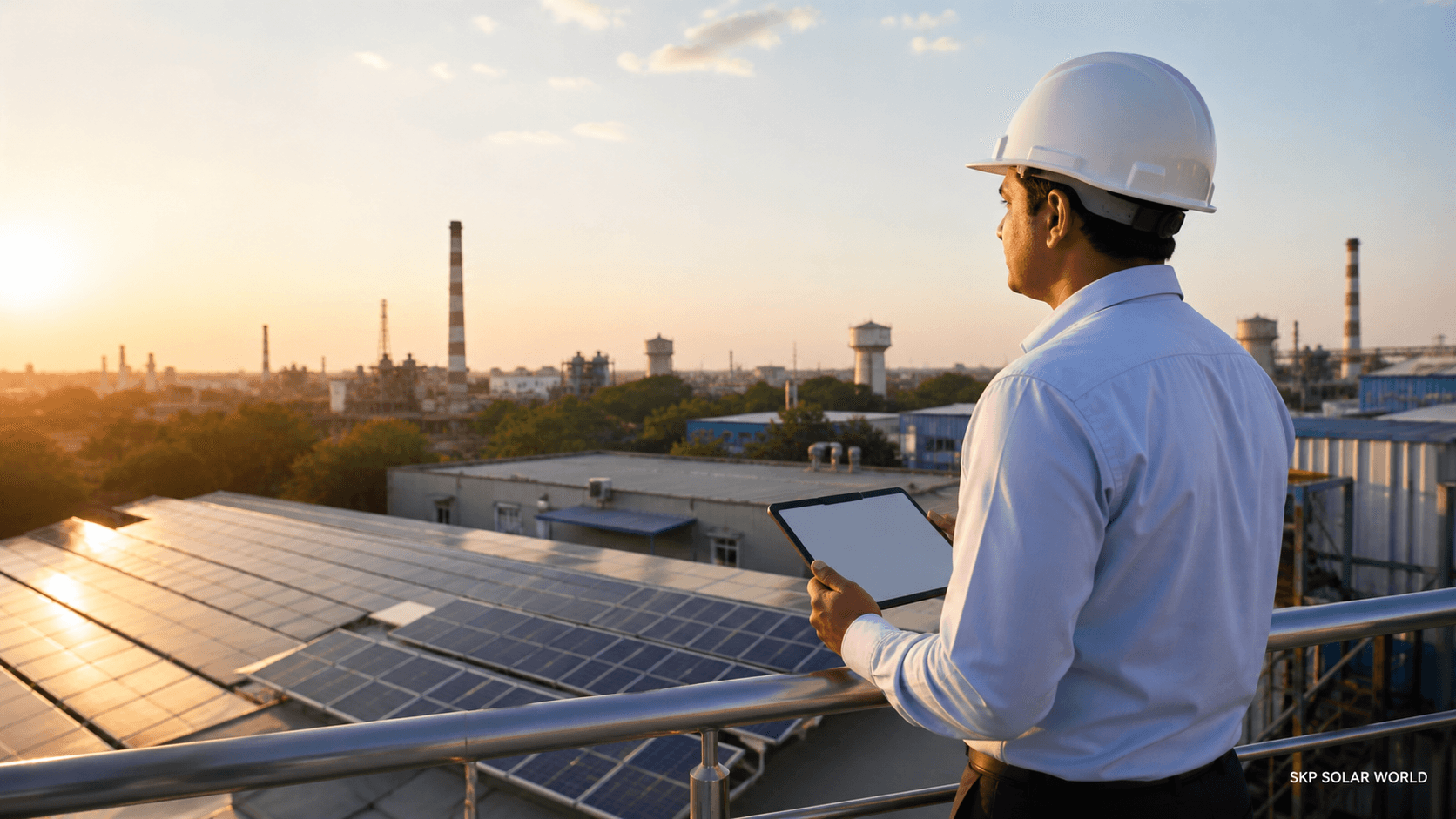
Grid reliability and energy security mean a steady, voltage-stable power supply for a business or factory, without heavy dependence on an erratic grid or costly diesel backup. For Indian industrial and commercial facilities…
A Grid Built for Growth, Not Always for Reliability
In July 2012, India experienced the largest power failure in recorded history: a cascading grid collapse that left roughly 600 million people without electricity at its peak. That event is now more than a decade old, but it remains the starkest reminder of a structural truth about India's power system: generation capacity has expanded faster than the distribution network's ability to deliver it reliably. A 2019 World Bank Global Competitiveness Report ranked India 108th out of 141 countries for electricity supply reliability, a sobering position for an economy that has since become the world's third-largest electricity consumer.
The good news is that the picture at the generation level has improved substantially. India's peak demand deficit, the gap between the power the grid needed to supply and what it could actually deliver, fell from 16.6 percent in 2007 to just 0.8 percent within about a decade, according to research summarized by the Regulatory Assistance Project. But that improvement sits mostly at the macro, generation-planning level. Distribution infrastructure in many circles, especially rural and peri-urban feeders that serve a large share of India's industrial estates, has not kept pace, and planned and unplanned outages remain routine in these zones.
What Power Instability Actually Costs a Business
The financial impact of an unreliable grid is not abstract. Research published through the Centre for Economic Policy Research's VoxEU platform, drawing on plant-level data from Indian manufacturing, found that electricity shortages reduce average annual plant revenues by 5 to 10 percent, with a comparable hit to producer surplus. In a simulated year of typical shortage severity, the study estimated revenue losses of roughly 5.6 percent and productivity losses of about 1.5 percent for the average plant. The same research found that a 10 percentage-point increase in shortage severity raised average fuel expenditure by 1.8 percent of revenue for plants that responded by running diesel generators, and that the proportional damage to profit was two to three times larger for small plants than for large ones.
Layer on top of outright shortages the subtler problem of voltage fluctuation, and the picture gets more expensive still. Voltage swings do not just interrupt power, they degrade it while it is flowing: motors run hot and wear faster, sensitive electronics and control systems reset or malfunction, and output quality on precision processes can drift without an obvious trigger. Unlike a full outage, voltage instability is often invisible until a machine fails or a batch is rejected, which makes it one of the harder power problems to budget for.
Why Demand Growth Is Making This Harder, Not Easier
India recorded a record peak electricity demand of 240 gigawatts in September 2023, a figure driven by rapid industrial and commercial expansion, and one that continues to climb as manufacturing capacity grows. At the same time, India has added over 150 gigawatts of renewable capacity, with solar installations growing roughly 275 percent cumulatively over five years, according to analysis from RMI. That is a genuine structural shift in how India generates power, built around the broader renewable energy in India transition.
But solar generation is concentrated in daylight hours, and India's grid operators have flagged a real risk of power shortfalls during the evening and nighttime ramp, when solar output drops away just as demand often peaks. The Ministry of Power has responded in recent summers by directing coal plants to run at maximum output on imported coal to cover the gap. For a business owner, the practical implication is that grid stress is not going away as capacity grows, it is shifting shape: fewer daytime shortages in many regions, but continued pressure and voltage instability at the edges of the solar day and on constrained distribution feeders.
A Smarter Way to Think About Energy Security
Given all of this, treating grid power as a fixed, always-on utility is no longer a safe planning assumption for a factory or commercial facility with real production or service continuity at stake. The more useful mental model is to think of the grid as one input among several, to be actively managed rather than passively relied upon. That shift in thinking is what underlies the broader move toward distributed generation and the wider adoption of solar energy at the point of consumption, rather than power generated far away and delivered through a long, congested electrical grid.
A facility that generates a meaningful share of its own daytime load reduces both its exposure to feeder-level outages and its dependence on grid voltage quality during working hours, which is when most production and commercial activity actually happens. It does not eliminate the need for a stable grid connection, but it changes the business's risk profile substantially.
What to Look for When Building Energy Security Into a Facility
- An accurate load and consumption profile. Any credible energy security plan starts with knowing exactly when and how much power a facility draws, including peak load moments and the equipment most sensitive to voltage quality.
- Correctly sized generation, not oversized or undersized. A system sized to actual daytime consumption avoids both underperformance and wasted capital, and should be based on measured data rather than rough estimates.
- Clarity on net metering and grid interaction. Businesses should understand, before committing to a system, exactly how excess generation will be exported, credited, or banked under their state's net metering rules, since this materially affects the return on investment.
- Component and installation quality that protects against the very problems being solved. Inverters, mounting structures, and protection equipment all need to be rated for the voltage and load conditions of the specific facility, inclusive of applicable GST and total landed cost, not just the lowest quoted price.
- A realistic view on storage and backup. Battery storage adds cost, so it should be evaluated against the facility's actual outage pattern and criticality of continuous power, rather than added by default.
- A written maintenance and monitoring plan. Ongoing performance monitoring is what turns a one-time installation into a long-term reliability asset, catching degradation or faults before they cause downtime.
Where Rooftop Solar Fits Into the Grid Reliability Picture
This is precisely the gap that a well-designed rooftop solar EPC project is built to close. SKP Solar World designs, supplies, and installs rooftop solar power systems for homes, businesses, and industrial facilities across India, with system sizing based on actual measured load rather than assumptions. For a factory or commercial property owner trying to reduce dependence on an unpredictable grid, the starting point is usually simple: compare your current electricity bill with a projected solar savings estimate and see how much of the daytime load a correctly sized rooftop system could realistically cover.
Facilities considering how a self-generated supply interacts with utility billing and export credits can also review how net metering applies to their specific load profile before finalizing a system size. And because component quality is what determines whether a system actually delivers on reliability over its operating life, it is worth asking any installer to walk through equipment specifications and workmanship warranties in detail, a conversation SKP Solar World's team runs through on every industrial and business enquiry via skpsolarworld.com.
Reducing grid dependence is rarely an all-or-nothing decision. It usually starts with a straightforward, no-pressure step: looking at what a facility is currently spending on power, and what a right-sized rooftop solar system could realistically offset. Business and factory owners in India who want that comparison in concrete numbers, rather than generic percentages, can get a facility-specific estimate by reaching out through SKP Solar World's site.
Frequently Asked Questions
Does rooftop solar fully protect a factory from grid outages?
Not on its own. A standard grid-tied rooftop solar system reduces how much power a facility draws from the grid during daylight hours, which lowers exposure to feeder-level issues during that window, but it does not provide backup during a full outage unless it is paired with battery storage or a hybrid inverter setup. Facilities that need continuous power through outages should evaluate storage as a separate, deliberate addition rather than assuming solar alone covers it.
Will rooftop solar help with voltage fluctuation problems specifically?
Indirectly, yes, in two ways. First, reducing the load a facility pulls from a congested or unstable feeder can ease the fluctuations caused by that congestion. Second, a properly specified solar installation includes its own protection equipment and quality inverters, which can improve power conditioning at the point of use. It is not a substitute for addressing upstream distribution issues, but it meaningfully reduces a facility's exposure to them.
How is net metering relevant to energy security, not just savings?
Net metering determines how a facility's excess daytime solar generation is credited against its grid consumption at other times, which affects both the financial return and how the facility manages its overall power balance. Understanding these rules before installation helps a business plan realistic energy security outcomes rather than relying on assumptions about export credits that may not match their state's actual regulations.
Is a bigger solar system always better for reliability?
No. Oversizing a system beyond what a facility's roof, sanctioned load, and consumption pattern can support usually wastes capital without improving reliability, since excess generation that cannot be used or exported efficiently does not translate into better power security. The more reliable approach is sizing based on an actual measured load profile.
How quickly does grid dependence typically reduce after installation?
Once a correctly sized system is commissioned, the reduction in grid draw during daylight hours is generally immediate, since the facility begins consuming self-generated power as soon as the system is operational. The scale of that reduction depends on how closely the system size matches the facility's actual daytime consumption pattern, which is why an accurate load assessment before installation matters more than the headline capacity of the system.
Sources
- Centre for Economic Policy Research (VoxEU), "Electricity shortages and industry: Evidence from India"
- Regulatory Assistance Project, "India's electric grid reliability and its importance in the clean energy transition"
- RMI, "Ensuring Grid Reliability in India"
Ready to Explore Solar for Your Property?
Model your own numbers in two minutes, or have an SKP engineer walk your roof and give you the conservative version.
You May Also Like
 Energy Insights
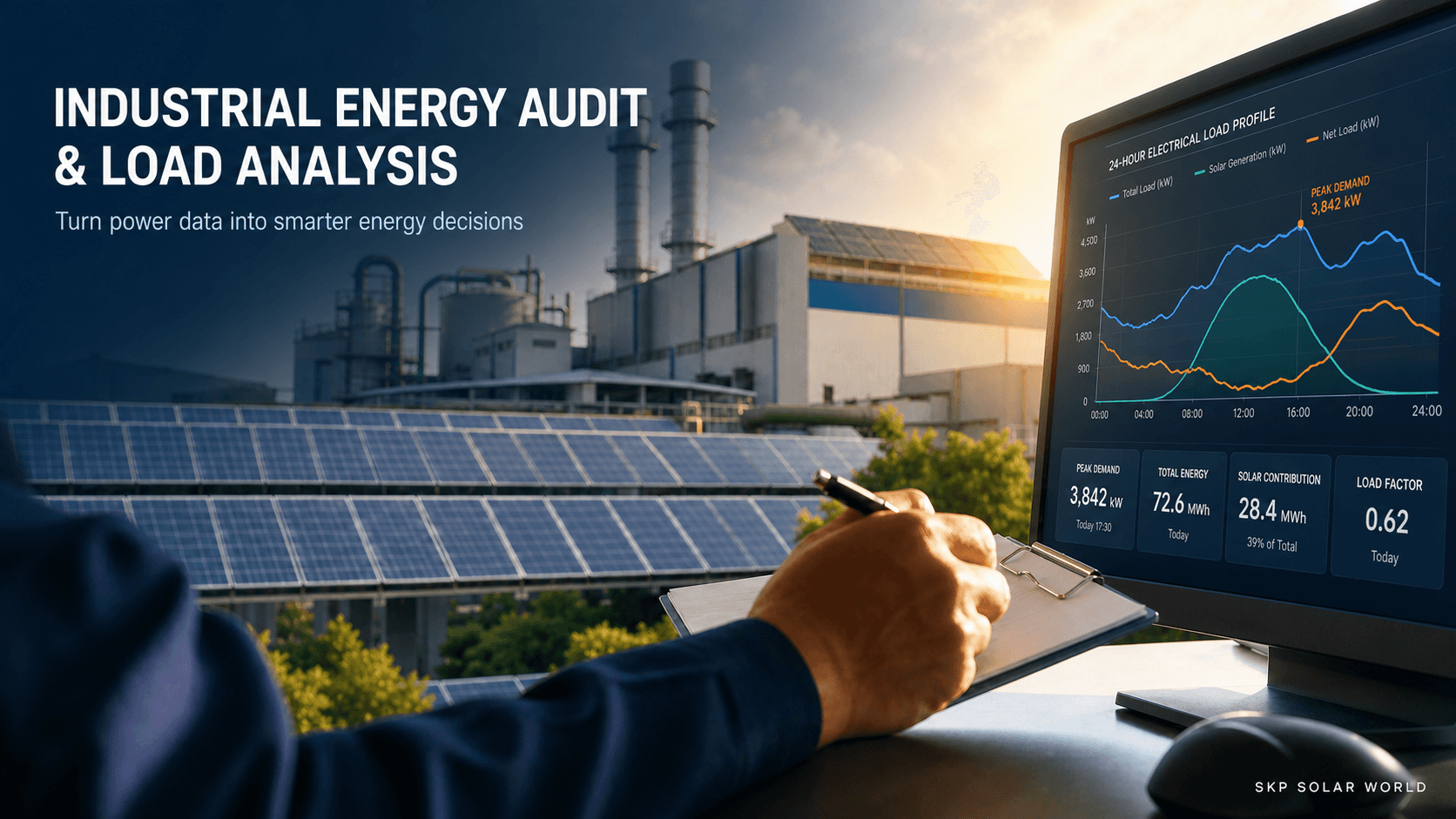
Industrial Energy Audit and Load Analysis: What Your Facility's Power Data Is Really Telling You
An industrial energy audit is a structured review of exactly how a facility uses electricity: which machines draw power, when peak demand spikes occur, and where energy is wasted through idle equipment, poor scheduling, or…
Read Article Energy Insights
How Indian Homes, Businesses, and Factories Are Cutting Monthly Electricity Bills with Rooftop Solar
India installed 2.7 GW of rooftop solar in just the first three months of 2026, a 125 percent jump over the same quarter last year, according to Mercom India data reported by pv magazine India.
Read Article Industrial Solar
Planning Power Capacity for Business Expansion: Rooftop Solar for Growing Indian Industries
A growing business needs more than new machinery and production capacity—it also needs a power plan that can scale with expansion. Rooftop solar helps industries reduce dependence on grid upgrades, control electricity costs, and add generation capacity in phases as demand grows. By planning solar alongside future load, roof availability, net metering, and open-access options, businesses can expand more efficiently and avoid costly power constraints later.
Read Article