
How Indian Homes, Businesses, and Factories Are Cutting Monthly Electricity Bills with Rooftop Solar
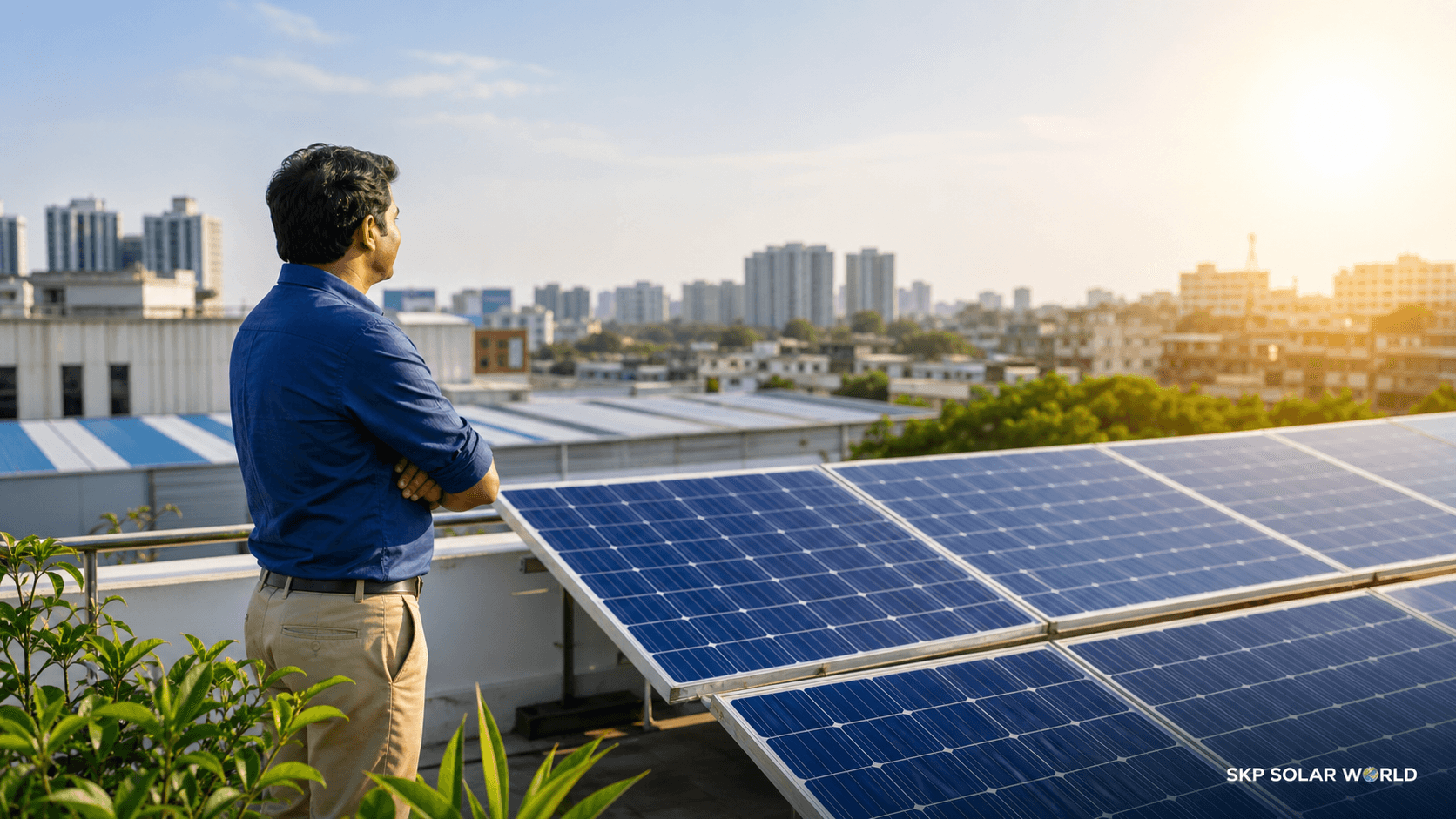
India installed 2.7 GW of rooftop solar in just the first three months of 2026, a 125 percent jump over the same quarter last year, according to Mercom India data reported by pv magazine India. That is not a niche trend. It is millions of electricity consumers deciding, at the same time, that buying every unit from the grid no longer makes financial sense.
Rooftop solar reduces monthly electricity bills by generating power at your own premises, which cuts the number of units you buy from the grid. A correctly sized system offsets a large share of daytime consumption, and net metering lets you earn credit for surplus units exported back to the grid. Indian homeowners can lower the upfront cost with central subsidies of up to ₹78,000 under PM Surya Ghar, while businesses and factories use solar as a hedge against annual tariff hikes. Actual savings depend on system size, roof condition, tariff category, and installation quality, which is why an accurate site assessment matters more than the lowest quote.
Why your electricity bill keeps climbing
Tariff revisions across Indian states have moved in one direction. For FY 2026, the Tamil Nadu Electricity Regulatory Commission approved a 3.16 percent retail tariff hike that applies to commercial and industrial consumers, as reported by Mercom India. Madhya Pradesh raised power tariffs across all consumer categories for FY 2025-26, with industrial energy charges rising by ₹0.20 per kWh, also per Mercom India.
Individually, these revisions look small. Compounded year after year, and stacked on top of fuel surcharges and fixed charges, they steadily widen the gap between what you budgeted for electricity and what you actually pay. Grid power is a cost you rent forever. You never finish paying for it.
What rising tariffs mean for you specifically
- Home owners: Higher slabs punish exactly the households whose consumption is growing, with air conditioning, appliances, and electric vehicles pushing monthly usage into more expensive tiers.
- Business owners: Commercial tariff categories are typically among the highest in every state, so shops, offices, hospitals, and schools pay a premium per unit compared to residential users.
- Factory and industrial unit owners: Electricity is often one of the top operating expenses. A per-kWh increase that looks minor on paper multiplies across lakhs of units consumed every month, directly compressing margins.
How rooftop solar actually reduces the bill
A rooftop solar system uses photovoltaic panels to convert sunlight into electricity right where you consume it. Every unit your roof generates is a unit you do not purchase at your DISCOM's retail rate. Three mechanisms drive the savings:
- Self-consumption: Daytime loads such as machinery, cooling, pumps, and appliances run directly on solar power, replacing grid units at your full applicable tariff.
- Net metering: Under net metering, surplus generation exported to the grid earns credit against the units you draw at night or on cloudy days, subject to your state's regulations.
- Subsidy and financing support: For residential systems, the PM Surya Ghar Muft Bijli Yojana provides central financial assistance of up to ₹78,000 depending on system size and consumption, along with collateral-free loans at around 7 percent interest for systems up to 3 kW, according to the Press Information Bureau. The scheme targets one crore households by March 2027.
The market has responded at scale. India's cumulative rooftop solar capacity reached 23.5 GW by the end of March 2026, and the residential segment alone accounted for 82 percent of new rooftop installations in Q1 2026, per Mercom data. This is part of a broader shift documented in the growth of solar power in India, where distributed generation is moving from early adopters to the mainstream.
A smarter way to evaluate the investment
Most buyers compare quotes on price per kW. That is the wrong first question. The right framework looks at cost per unit generated over 25 years, because a cheap system that underperforms or degrades early costs far more per unit than a well-engineered one. Before comparing vendors, get clear on five things:
- Your actual load profile: When do you consume power, and how much of it falls in daylight hours?
- Your sanctioned load and tariff category: These determine how much you save per unit offset and what net metering allows in your state.
- Roof condition and structure: Orientation, shading, and load-bearing capacity decide real-world generation, not the brochure number.
- Total cost of ownership: Ask for GST-inclusive pricing, and factor in inverter replacement, cleaning, and monitoring over the system's life.
- Regulatory paperwork: Subsidy applications, net metering approvals, and DISCOM coordination can delay a project for months if handled poorly.
What to look for in a rooftop solar provider
- End-to-end EPC scope: design, engineering, supply, installation, and commissioning under one accountable contract, not a loose chain of subcontractors.
- A site-specific generation estimate based on your roof and load data, not a generic per-kW promise.
- Transparent component specifications: module make and wattage, inverter brand, structure material, and cabling detailed in writing.
- Hands-on support for net metering applications and subsidy paperwork in your state.
- Written workmanship warranty and a clear after-sales service commitment, separate from manufacturer warranties.
- Experience across your building type, whether a residence, commercial premises, or an industrial shed.
Where SKP Solar World fits in
Everything above is the checklist we built our own process around. SKP Solar World is a rooftop solar EPC company serving homes, businesses, and industrial facilities in India, handling design, supply, installation, net metering coordination, and after-sales support as one accountable scope. If you are still at the evaluation stage, you can request a site assessment for your home or facility before committing to any system size or budget.
The simplest next step costs nothing: compare your current electricity bill with your projected solar savings at skpsolarworld.com. Share a recent bill, and you will get a clear picture of the system size your roof supports, the subsidy or financing routes available to you, and what your monthly outgo could look like once the sun starts paying part of it.
Frequently asked questions
How much can rooftop solar reduce a monthly electricity bill in India?
It depends on how much of your consumption the system can offset. Savings are driven by system size, your daytime usage, your tariff rate, and your state's net metering rules. A household consuming mostly in the evening saves differently from a factory running day shifts. This is why a load-profile-based estimate from a qualified installer is more reliable than any generic percentage claim.
Is there a government subsidy for rooftop solar in 2026?
Yes, for residential consumers. PM Surya Ghar Muft Bijli Yojana offers central financial assistance of up to ₹78,000 based on system size and monthly consumption, plus access to collateral-free loans at around 7 percent interest for systems up to 3 kW. Commercial and industrial consumers do not receive this subsidy, but their higher tariffs mean each solar unit offsets a more expensive grid unit, which strengthens the underlying economics.
What happens at night or during cloudy weather?
Your premises draw power from the grid as usual. Where net metering applies, credits earned from daytime exports reduce the net units billed. For sites that need power continuity during outages, battery storage can be added, though it is a separate investment decision from bill reduction.
How do I know what system size my roof needs?
Start from your electricity bills, not from the roof. Twelve months of consumption data, your sanctioned load, and a physical shading and structural survey together determine the right capacity. An oversized system wastes capital where export compensation is weak, and an undersized one leaves savings on the table. You can start a system sizing conversation with the SKP Solar World team using just your recent bills.
Sources
- pv magazine India: Residential segment accounts for 82% of India's rooftop solar additions in Q1 2026 (Mercom)
- Mercom India: Tamil Nadu Hikes FY 2026 Electricity Tariffs by 3.16%
- Mercom India: Madhya Pradesh Increases Power Tariffs Across All Categories
- Press Information Bureau: PM Surya Ghar Muft Bijli Yojana
Ready to Explore Solar for Your Property?
Model your own numbers in two minutes, or have an SKP engineer walk your roof and give you the conservative version.
You May Also Like
 Energy Insights
Grid Reliability and Energy Security: Why Indian Industries Are Rethinking Their Power Supply
Grid reliability and energy security mean a steady, voltage-stable power supply for a business or factory, without heavy dependence on an erratic grid or costly diesel backup. For Indian industrial and commercial facilities…
Read Article Energy Insights
Industrial Energy Audit and Load Analysis: What Your Facility's Power Data Is Really Telling You
An industrial energy audit is a structured review of exactly how a facility uses electricity: which machines draw power, when peak demand spikes occur, and where energy is wasted through idle equipment, poor scheduling, or…
Read Article Industrial Solar
Planning Power Capacity for Business Expansion: Rooftop Solar for Growing Indian Industries
A growing business needs more than new machinery and production capacity—it also needs a power plan that can scale with expansion. Rooftop solar helps industries reduce dependence on grid upgrades, control electricity costs, and add generation capacity in phases as demand grows. By planning solar alongside future load, roof availability, net metering, and open-access options, businesses can expand more efficiently and avoid costly power constraints later.
Read Article