
Home Solar Panel Efficiency and Degradation in India: What Homeowners Should Expect
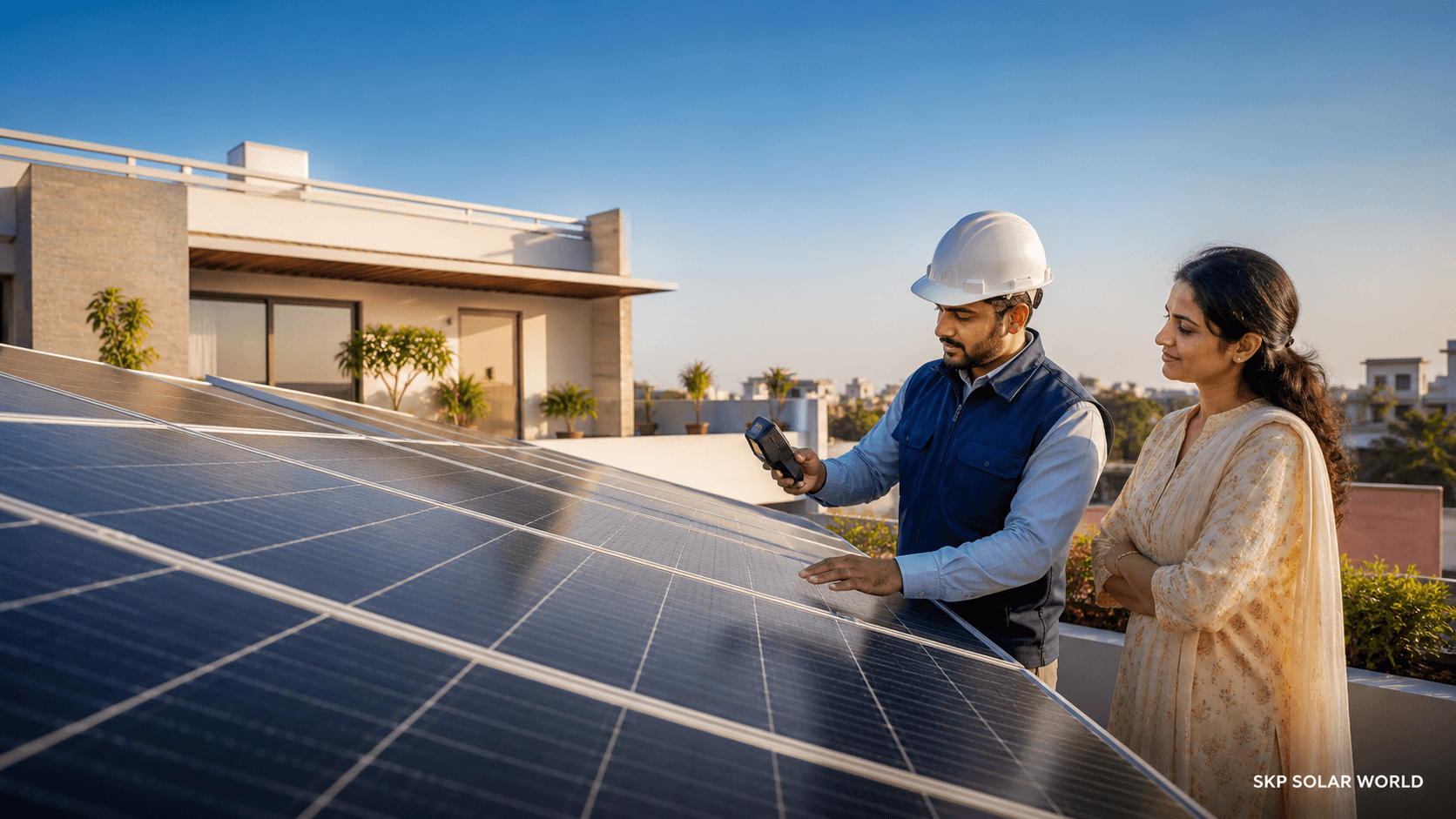
Modern rooftop solar panels on Indian homes typically lose 0.5% to 0.9% of their output every year, per the National Renewable Energy Laboratory's global degradation study of crystalline silicon panels. Over 25 years, a well-built system still delivers the large majority of its original power.
Why "25-Year Panels" Still Make Homeowners Nervous
Rooftop solar is no longer a niche purchase in India. The Ministry of New and Renewable Energy (MNRE) reported that the country had installed 23.16 GW of grid-connected rooftop solar as of November 30, 2025, part of a total installed solar capacity of 132.85 GW nationwide, according to reporting on MNRE data by pv magazine India. Rooftop growth has since accelerated sharply: research firm data cited by Down To Earth shows India added around 6.4 GW of new rooftop capacity in just the first half of 2026, a 104% jump over the same period a year earlier, driven largely by the PM Surya Ghar Muft Bijli Yojana scheme.
Yet ask a homeowner who is still deciding, and the hesitation is almost always the same: will the panels on my roof still be producing meaningful power ten, fifteen, twenty-five years from now, or will I be stuck with an expensive asset quietly losing value? It is a fair question. Photovoltaic technology converts sunlight directly into electricity through a semiconductor process, and like any physical material exposed to sun, heat, and weather for decades, the cells inside a panel do change over time. The question that actually matters is by how much, and what determines whether that change stays small or becomes a real problem.
How Fast Do Solar Panels Actually Lose Power?
This is where data helps more than marketing claims. NREL's Compendium of Photovoltaic Degradation Rates, one of the most cited global studies on panel aging, found median degradation for crystalline silicon panels in the 0.5% to 0.6% per year range, with the mean (average, including weaker-performing panels) sitting a bit higher at 0.8% to 0.9% per year.
Put simply: a typical panel producing 400 watts on day one might still be producing somewhere close to 350 to 380 watts after two decades of Indian sun, if the system was built with quality components and installed correctly. That is a manageable, predictable decline, not a cliff edge. The panels that disappoint homeowners are usually not failing because solar energy technology is unreliable. They are failing because the specific modules used were poorly manufactured, poorly tested, or poorly matched to Indian roof conditions in the first place.
What's Actually Happening Inside a Degrading Panel
Three forces drive most of the gradual output loss homeowners eventually notice:
- Light-induced degradation, a small, largely one-time efficiency drop that happens in the first weeks of a panel's exposure to sunlight, before output stabilizes.
- Thermal cycling, the daily expansion and contraction of materials as rooftop temperatures swing between hot afternoons and cool nights, which stresses solder joints and cell connections over years.
- Potential-induced degradation, a slower electrical leakage effect that can appear in panels with weaker encapsulation or lower manufacturing tolerances, especially in humid or high-heat climates.
None of these are unusual or alarming on their own. Every panel experiences some version of them. What separates a system that ages gracefully from one that underperforms within a few years is the quality of the cells, the encapsulation material, and the manufacturing process, none of which a homeowner can inspect just by looking at a spec sheet.
The Rule Reshaping Panel Quality in India
This is precisely the gap the government's ALMM framework was built to close. Under MNRE's Approved List of Models and Manufacturers policy, only panels from tested, registered manufacturers can be used in government-linked solar schemes, open-access projects, and net-metering installations, because, as MNRE states, rooftop systems "are generally set up for a period of 25 years and solar PV cells and modules used in plants require long term warranty." From June 1, 2026, that requirement tightened further: a new List-II rule now requires that ALMM-listed panels use solar cells sourced only from approved domestic cell manufacturers, not just approved panel assemblers. According to SolarSquare's analysis of the rule change, this is expected to raise rooftop installation costs by roughly ₹3,000 per kilowatt, and it applies to new residential systems claiming PM Surya Ghar subsidies. That cost increase is easy to resent in the moment, but its purpose is directly relevant to this article's question: it closes a loophole where the panel label said one thing while the cells inside were of inconsistent, unverified quality, which is one of the biggest hidden drivers of faster-than-expected degradation.
What a Smart Buyer Should Ask Before Signing
Given all of this, degradation should not be treated as an afterthought you check once the contract is already signed. It should shape how you evaluate every quote you receive. Before committing to a system, a homeowner should be asking the installer:
- Are these panels currently ALMM List-I and, where applicable from June 2026, List-II compliant?
- Does the panel manufacturer, not just the installer, offer a written linear performance warranty?
- What third-party test certifications (such as IEC standards for design qualification and safety) back these specific modules?
- Will I have access to generation data after installation, so degradation is something I can see, not something I have to assume?
- How does GST apply to the equipment and installation portions of my quote, and is that reflected in the final price I am comparing across vendors?
If an installer cannot answer these clearly, or seems irritated that you asked, that itself is useful information about how they'll handle your system twenty years from now.
What to Look for in a 25-Year Home Solar Investment
- ALMM-listed modules with documented compliance, not a verbal assurance.
- A manufacturer-backed linear performance warranty in writing, separate from the installer's workmanship warranty.
- Independent test certification for the specific panel model being quoted, not just the brand in general.
- Post-installation monitoring so you can track real output against expected output over time.
- An installer with a maintenance track record long enough to still be around, and accountable, a decade from now.
- Transparent degradation disclosure before you sign, not vague promises of "lifetime performance."
This is the same standard that SKP Solar World applies when designing rooftop systems for homes across India. As a rooftop solar EPC company handling design, supply, and installation end to end, the priority is building systems around ALMM-compliant modules and manufacturer-backed warranties, not just the lowest quote on a page. Homeowners deciding between vendors can request a free rooftop assessment from SKP Solar World to see exactly which panel specifications, degradation profile, and warranty terms are being proposed for their roof before they commit.
Because the honest answer to "will my panels still work in 25 years" depends less on the word "solar" and more on which specific components sit on your roof, it is worth treating that verification step as seriously as the price itself. Homeowners who want to see the numbers for their own home can compare their current electricity bill with a projected solar savings estimate at SKP Solar World, and get a clear view of expected output, degradation, and payback before making a decision.
If you are already exploring quotes, it is worth asking every vendor you shortlist, including SKP Solar World's rooftop solar design and installation team, to walk you through the specific ALMM listing and warranty documentation for the exact panels they plan to install, not a generic brochure. A twenty-minute conversation now is far cheaper than discovering a quality gap in year eight.
Frequently Asked Questions
How much power will my solar panels lose over 25 years?
Based on NREL's global degradation data, crystalline silicon panels typically lose between 0.5% and roughly 0.9% of their output per year on average. Over 25 years, that generally means a quality system is still producing a large majority of its original output, though the exact figure depends on panel quality, installation, and local climate conditions.
Do cheaper, non-branded panels degrade faster than well-known brands?
Not automatically by brand name, but lower-cost panels are more likely to skip the manufacturing controls and testing that keep degradation predictable. Checking ALMM listing and independent test certification is a more reliable indicator of long-term quality than price or brand recognition alone.
What is ALMM and why should I care about it as a homeowner?
ALMM is MNRE's Approved List of Models and Manufacturers. It restricts government-linked solar schemes, including PM Surya Ghar-subsidized rooftop systems and net-metering installations, to panels from tested, registered manufacturers. It exists specifically because 25-year solar investments need dependable long-term warranties, which is exactly the concern most homeowners have about degradation.
Can I actually check how much my panels have degraded after installation?
Yes, if your system includes generation monitoring. Comparing your system's real monthly output against its expected output (adjusted for season and weather) lets you see degradation trends directly, rather than relying on assumptions or waiting until output drops noticeably.
Does India's heat make panels degrade faster than in cooler countries?
Higher and more frequent temperature cycling can add stress to panel materials over time, which is one reason thermal cycling is one of the recognized degradation mechanisms. This is precisely why manufacturing quality and certified testing matter more, not less, in Indian rooftop conditions.
Sources
- National Renewable Energy Laboratory: Compendium of Photovoltaic Degradation Rates
- pv magazine India: India Surpasses 132 GW of Installed Solar Capacity (MNRE data)
- Down To Earth: India Adds Record 29 GW Solar and Wind Capacity in H1 2026
- Ministry of New and Renewable Energy: Approved List of Models and Manufacturers (ALMM)
- SolarSquare: MNRE Approved Solar Panels, New ALMM List-II Rule in 2026
- SolarQuarter: PM Surya Ghar Muft Bijli Yojana Powers Over 25 Lakh Homes with Rooftop Solar
- Press Information Bureau: PM Surya Ghar Muft Bijli Yojana
Ready to Explore Solar for Your Property?
Model your own numbers in two minutes, or have an SKP engineer walk your roof and give you the conservative version.
You May Also Like
 Solar Technology
Solar Performance Monitoring for Industrial Rooftop Systems: What to Track After Installation
Solar performance monitoring is the ongoing tracking of how much electricity a rooftop solar system actually generates, compared to what it should generate, using inverter data, sensors, and dashboards. For industrial and…
Read Article Solar Technology
Solar Panel Quality Standards in India: What Every Business Should Verify Before Installing Rooftop Solar
Solar quality standards in India center on two checks: BIS certification (modules must meet IS 14086, inverters must meet IS 16221) and MNRE's Approved List of Models and Manufacturers (ALMM), which is model-specific rather than…
Read Article Industrial Solar
Planning Power Capacity for Business Expansion: Rooftop Solar for Growing Indian Industries
A growing business needs more than new machinery and production capacity—it also needs a power plan that can scale with expansion. Rooftop solar helps industries reduce dependence on grid upgrades, control electricity costs, and add generation capacity in phases as demand grows. By planning solar alongside future load, roof availability, net metering, and open-access options, businesses can expand more efficiently and avoid costly power constraints later.
Read Article