
Solar Performance Monitoring for Industrial Rooftop Systems: What to Track After Installation
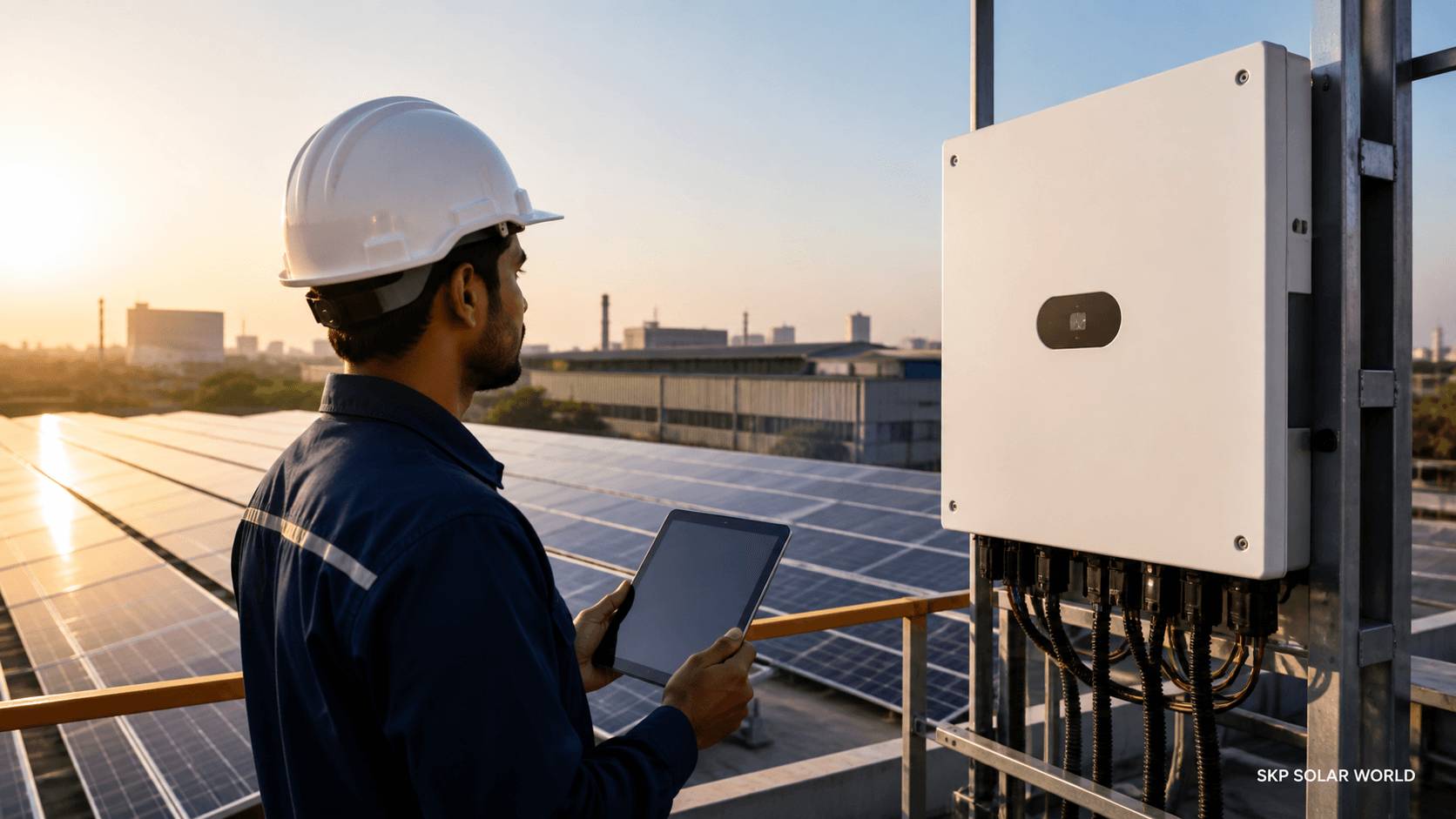
Solar performance monitoring is the ongoing tracking of how much electricity a rooftop solar system actually generates, compared to what it should generate, using inverter data, sensors, and dashboards. For industrial and…
The monitoring gap most businesses do not know exists
India's rooftop solar capacity crossed 23.2 GW by the end of November 2025, accounting for roughly 17% of the country's total 133 GW of installed solar capacity. Yet, as of that point, the government had no systematic way to confirm how much electricity most of that installed capacity was actually producing, because generation data sat scattered across individual consumer meters and distribution company systems rather than in one place, according to a Down To Earth report on India's rooftop solar generation blind spot. In December 2025, the Ministry of New and Renewable Energy directed state electricity commissions to adopt machine-to-machine, SIM-based remote monitoring for new rooftop installations under the PM Surya Ghar scheme, precisely to close that gap going forward.
The catch for existing systems: that mandate applies only to new installations. Businesses that installed rooftop photovoltaic systems before the rule took effect are left to decide, largely on their own, whether they will retrofit real-time monitoring or keep relying on whatever the original vendor bundled in at commissioning.
Why performance losses hide in plain sight
Rooftop solar is not a "install once and forget" asset, even though it is often sold and bought that way. A facility owner who never looks past the monthly generation total on a bill can miss weeks or months of underperformance, because a system that is still producing some power looks fine at a glance even when it is producing far less than it should.
The commercial and industrial segment is also the fastest-growing part of India's rooftop market, which raises the stakes. India added 7.1 GW of rooftop solar capacity in 2025, more than double the 3.2 GW added in 2024, a 122% year-on-year jump, with the industrial segment alone contributing about 18% of that growth and capital-expenditure (capex) ownership models accounting for 85% of new installations, per Mercom Capital Group data reported by pv magazine. Under a capex model, the business owns the asset outright, which means the business also owns full responsibility for catching problems that a lease or power purchase structure might otherwise push back onto a third party.
Two of the most common, and most preventable, sources of loss:
- Soiling. Dust, pollution, and organic debris accumulating on panels reduces energy yield by an average of 4% to 7% globally when left unmanaged, according to the International Energy Agency's Photovoltaic Power Systems Programme (IEA-PVPS) fact sheet on soiling losses. In dusty industrial zones or near construction activity, the impact can run higher, and it is cumulative: a system that is not tracked will simply keep losing output, month after month, with no alert to prompt a cleaning cycle.
- Undetected faults and irregular maintenance. Industry commentary from solar operations firms indicates that irregular maintenance and poor post-installation follow-up can reduce a plant's electricity generation by 15% to 25% annually, translating into lakhs, and in larger installations crores, of rupees in unrecovered revenue over a system's lifetime, per reporting on maintenance-related revenue loss in Indian solar plants. The same reporting notes that even short periods of inverter downtime or unclean panels create measurable revenue loss for commercial and industrial consumers specifically, because their systems tend to be larger and their electricity rates higher than residential customers.
What performance monitoring actually measures
Monitoring is not the same thing as simply generating power. A functioning inverter will produce a generation number every day whether or not that number reflects what the system is capable of. What monitoring adds is context: a way to compare actual output against expected output, spot the gap, and act on it before it compounds.
A properly configured monitoring setup for an industrial or commercial rooftop solar system typically tracks:
- Daily and cumulative generation against the system's rated capacity and site-specific irradiance, to calculate a performance ratio, the standard industry measure of how efficiently a plant converts available sunlight into usable electricity.
- Inverter-level and, on larger systems, string-level output, so a fault in one section of the array does not go unnoticed simply because the rest of the system is performing normally.
- Fault and alarm signals from inverters, including trip events, communication loss, and abnormal shutdowns, ideally pushed to the facility owner or maintenance team as an alert rather than buried in a log file no one checks.
- Export and import data where the system is connected under net metering, so the business can reconcile what the distribution company is billing against what the system is actually sending to and drawing from the grid.
Left unmonitored, none of this is invisible in the sense that the data does not exist. It is invisible in the sense that nobody is looking at it. That distinction is what separates a solar investment that quietly underdelivers for years from one that gets caught and corrected within days.
The buying criteria smart businesses now use
As more industrial and commercial buyers get burned by systems that looked fine on paper and underperformed in practice, the criteria for evaluating a rooftop solar proposal have shifted. Price per watt and panel brand still matter, but they are no longer the whole conversation. Buyers who have been through a full ownership cycle increasingly ask about:
- What monitoring is included, and for how long. A dashboard that is bundled for the warranty period and disappears once that subscription lapses is a common pattern, and a business should know upfront whether monitoring is a permanent feature of the system or a temporary perk, per the Energetica India analysis of India's rooftop monitoring gaps.
- Who receives the fault alerts. A monitoring system that only the installer can see, with no visibility for the facility owner, does not give the business any real control over its own asset.
- Whether the vendor treats commissioning as the finish line or the starting point. A vendor whose engagement effectively ends once the system is switched on has little incentive to catch problems that surface six months or two years later.
- How generation data reconciles with the electricity bill. A business should be able to independently verify that the savings promised at the time of sale are the savings actually showing up, month over month, not just take a vendor's word for it.
What to look for in a monitoring setup
- Real-time or near real-time data, not monthly manual meter readings.
- Inverter-level (and string-level, for larger systems) granularity, not just a single site-wide total.
- Automated fault and underperformance alerts sent directly to the facility owner or their designated staff.
- Monitoring access that continues for the operational life of the system, not just the initial warranty window.
- A generation history that can be exported or referenced independently, useful for internal reporting, ESG documentation, or resolving a dispute over billed savings.
- A vendor who proactively flags anomalies rather than waiting for the customer to notice a high electricity bill and ask questions.
Building visibility into the system from day one
This is the layer that a design, supply, and installation partner should be building in from the start rather than retrofitting after a complaint. At SKP Solar World, rooftop systems for homes, businesses, and industrial facilities are designed with performance visibility as part of the specification, not an optional add-on negotiated after the fact. For an industrial or commercial facility, that means generation and fault data the business can actually see, not just a number the installer glances at once and moves on from.
Because most performance loss is preventable once it is visible, the practical value of working with a partner who treats post-installation monitoring as part of the EPC scope compounds over the life of the system. A facility owner evaluating a new rooftop project, or trying to understand why an existing one is not delivering the savings it was sold on, gains more from a partner who can show the data than from one who simply asserts the system is working fine.
For businesses further along, already operating a system and unsure whether it is hitting its numbers, SKP Solar World's team can review existing generation data and site conditions to identify where output is being left on the table, whether that is a soiling issue, an underperforming inverter, or a monitoring gap that has been hiding the real picture all along.
The most direct way to start that conversation is simple: pull your last few electricity bills and compare your current bill with projected solar savings at skpsolarworld.com. Seeing the two numbers side by side, with GST and applicable charges factored into the comparison, tends to make the case for visibility, and for solar itself, more clearly than any sales pitch can.
Frequently asked questions
What is solar performance monitoring, in plain terms?
It is the practice of continuously tracking how much electricity a rooftop solar system generates and comparing that figure against how much it should be generating, given its size and local sunlight conditions. The goal is to catch a gap between expected and actual output quickly, rather than discovering it months later through a higher-than-expected electricity bill.
Does an industrial rooftop system really lose that much output without monitoring?
The scale of loss varies by site and cause, but soiling alone accounts for an average global energy yield loss of 4% to 7% when panels are not cleaned on a proper schedule, and industry reporting on irregular maintenance points to generation shortfalls of 15% to 25% where problems go undetected for extended periods. Both figures point to the same underlying issue: losses that would be easy to catch with monitoring often go unnoticed without it.
Is monitoring included with every rooftop solar system, or is it an extra cost?
It depends entirely on the vendor and the terms of the contract. Some installers bundle monitoring access for a limited period tied to the equipment warranty, after which the dashboard can become inaccessible unless the customer renews a subscription. A business evaluating a proposal should ask specifically how long monitoring access lasts and who owns that data over the life of the system.
What is a good performance ratio for an industrial rooftop system in India?
A performance ratio compares a system's actual electricity output to its theoretical maximum output under the sunlight it actually received. Well-designed, well-maintained systems in India typically operate in a strong performance ratio range, and a business that is monitoring its system can track this figure over time and flag a decline early, rather than only noticing a problem once it shows up as a smaller-than-expected saving on the electricity bill.
Can monitoring be added to a system that is already installed?
In many cases, yes. Inverter-level monitoring can often be retrofitted onto an existing rooftop system, either through the original manufacturer's platform or a third-party monitoring solution, though the options depend on the inverter brand and age of the installation. A facility owner unsure of what is possible for their existing system can have it assessed before deciding whether a retrofit or a fuller system review makes more sense.
Last updated: July 25, 2026
By Mr. Ravinder Pabla, Founder, SKP Solar World
Sources
- Down To Earth: As rooftop solar scales up, India confronts a generation blind spot
- pv magazine: India installs 7.1 GW rooftop solar in 2025, residential demand surges
- IEA-PVPS: Fact Sheet on Understanding, Measuring, and Mitigating Soiling Losses in PV Power Systems
- Energetica India: An Integrated Remote Monitoring, The Missing Link in India's Rooftop Solar Expansion
- Impressive Times: Irregular Maintenance of Solar Plants Causing Heavy Revenue Losses, Warn Experts
Ready to Explore Solar for Your Property?
Model your own numbers in two minutes, or have an SKP engineer walk your roof and give you the conservative version.
You May Also Like
 Solar Technology
Home Solar Panel Efficiency and Degradation in India: What Homeowners Should Expect
Modern rooftop solar panels on Indian homes typically lose 0.5% to 0.9% of their output every year, per the National Renewable Energy Laboratory's global degradation study of crystalline silicon panels. Over 25 years, a well-built system still delivers the large majority of its original power.
Read Article Solar Technology
Solar Panel Quality Standards in India: What Every Business Should Verify Before Installing Rooftop Solar
Solar quality standards in India center on two checks: BIS certification (modules must meet IS 14086, inverters must meet IS 16221) and MNRE's Approved List of Models and Manufacturers (ALMM), which is model-specific rather than…
Read Article Industrial Solar
Planning Power Capacity for Business Expansion: Rooftop Solar for Growing Indian Industries
A growing business needs more than new machinery and production capacity—it also needs a power plan that can scale with expansion. Rooftop solar helps industries reduce dependence on grid upgrades, control electricity costs, and add generation capacity in phases as demand grows. By planning solar alongside future load, roof availability, net metering, and open-access options, businesses can expand more efficiently and avoid costly power constraints later.
Read Article