
Planning Power Capacity for Business Expansion: Rooftop Solar for Growing Indian Industries

When a factory or business expands, electricity demand usually rises faster than the local grid connection can be upgraded. The practical fix is to plan power capacity in parallel with expansion, not after it. Rooftop solar…
Why expansion puts pressure on power planning
India's electricity demand is on a steep upward path. The International Energy Agency projects that demand in India will grow at an average of 6.4% a year through 2030, adding more than 570 terawatt-hours of annual consumption over that period, with the industrial sector alone expected to drive roughly a third of that growth (IEA, Electricity 2026). That is not an abstract national number. It plays out at the level of individual factories and business premises: a new production line, an added shift, a bigger cold store, or a new floor of commercial space all pull directly on a facility's sanctioned load.
The problem is that physical business growth and grid capacity growth do not move at the same speed. Adding sanctioned load through a distribution company typically means fresh paperwork, inspection, and queueing behind other requests in the area, and in many circuits the local transformer or feeder itself needs augmentation before extra load can be released. A business that has already committed capital to a new line or a new shift cannot always afford to wait for that process to clear.
What the data shows about how businesses are responding
Indian industry is already voting with its capital allocation. Rooftop solar installations across the country reached about 8.7 GW in FY2026, a 69% jump over the previous year, with commercial and industrial demand cited as a major contributor to that acceleration (JMK Research). Open access solar, which lets larger consumers buy power from an offsite solar plant instead of only generating on their own roof, grew even faster: India added 2.7 GW of open access capacity in the first quarter of 2026 alone, a 55% jump from the previous quarter (Mercom India). Industry sources in that same report estimate that large industrial consumers can now realistically replace 40 to 50% of their electricity requirement through open access clean energy, precisely because it does not depend on available rooftop area alone. There is also a large amount of headroom still sitting unused. IEEFA's analysis of India's C&I rooftop market notes that MSMEs account for roughly half of India's industrial electricity consumption, yet still have close to 15 GW of rooftop solar potential that remains untapped. In plain terms, a large share of the businesses that will need more power capacity in the next few years already have unused roof space that could be generating it.
Rethinking capacity planning: from "add more grid load" to "add more generation"
The instinct during expansion is to treat the grid connection as the only lever: bigger sanctioned load, bigger transformer, bigger bill. Photovoltaic generation on the roof, or contracted from an offsite solar plant through open access, is a second lever that businesses in solar power in India are increasingly pulling alongside the first one. Instead of asking "how much more load can the DISCOM release us," the more useful question becomes "how much of the new demand can we generate or contract ourselves, and how much residual load do we actually need from the grid." This reframing matters because it changes what "smart capacity planning" looks like for a growing business. A facility that sizes its solar system only for today's consumption will need a second, disruptive round of work the moment it expands. A facility that plans its rooftop area, structural load allowance, and net metering agreement with future phases in mind can add capacity in a fraction of the time a fresh grid sanction takes.
What to look for when planning power capacity ahead of growth
- Phased system design. A system architecture that allows a second or third array to be added later without redesigning the inverter and metering setup from scratch.
- Roof and structural headroom. An assessment that accounts for future expansion of the built-up area, not just the current rooftop footprint.
- Realistic load forecasting. Sizing based on where consumption is headed over the next three to five years, not only the last twelve months of bills.
- Net metering and open access literacy. A partner who understands both rooftop net metering rules and open access power procurement, since larger expansions often need both working together.
- Single point of accountability for approvals. One team managing DISCOM paperwork, structural sign-off, and commissioning, rather than the business having to coordinate multiple vendors during an already busy expansion period.
- Transparent generation reporting. Ongoing visibility into how much of the expanded load is actually being met by solar versus grid power, so future phases can be planned on real numbers.
This is exactly where SKP Solar World works alongside growing businesses and industrial facilities across India. As a rooftop solar EPC partner, SKP Solar World designs systems around where a business is headed, not just where it stands today, so that adding capacity later does not mean starting over. Businesses evaluating an expansion can compare their current electricity bill with a projected solar savings estimate before committing to a larger grid sanction. For facilities where the roof alone will not cover the new demand, SKP Solar World also helps businesses assess whether a combination of rooftop solar and open access power fits their expansion plan. And because expansion timelines are usually tight, the practical next step is to get a site-specific capacity plan from SKP Solar World before the next phase of construction locks in the electrical layout. For businesses that already have a system installed and are now scaling operations, it is also worth an assessment of how much additional capacity the existing rooftop array can support before any new load is sanctioned.
If a new line, shift, or facility is already on the calendar, the sooner power capacity is planned alongside it, the fewer compromises the business has to make later. A short conversation with SKP Solar World today can save a much longer wait at the DISCOM counter tomorrow, and the reader can compare their current electricity bill with their projected solar savings at skpsolarworld.com to see where that conversation should start.
Frequently asked questions
Can rooftop solar capacity be added in phases as a business grows?
Yes, when the system is designed for it from the start. A rooftop solar installation can be planned with spare inverter capacity, wiring, and metering headroom so that a second phase can be added later without reworking the entire system, provided the original design anticipated future expansion.
Does expanding sanctioned load also require reapproving an existing rooftop solar or net metering setup?
In most cases, a net metering agreement is tied to the sanctioned load on record, so a significant increase in sanctioned load typically requires informing the DISCOM and may involve an updated net metering application, especially if the solar capacity itself is also being increased.
Is open access solar a better fit than rooftop solar for a large expanding factory?
It depends on available roof area relative to the new demand. Industry estimates suggest large industrial consumers can replace 40 to 50% of their electricity requirement through open access clean energy, which makes it a useful complement when rooftop space alone cannot cover the expanded load.
How much of a facility's expanded electricity demand can rooftop solar realistically cover?
This depends on available roof area, local irradiance, and the facility's load profile. A proper feasibility assessment, rather than a generic percentage, is the only reliable way to determine what share of expanded demand rooftop solar can meet on its own.
What happens to an existing solar system if a business expands its facility or adds a new production line?
The existing system continues generating as before, but it will only meet a smaller share of the new, larger total demand unless additional capacity is added. This is why planning for future phases at the time of the original installation is more efficient than retrofitting later.
Last updated: July 29, 2026
By Mr. Ravinder Pabla, Founder, SKP Solar World
Sources
- IEA, "Electricity 2026: Demand"
- JMK Research, "India Installs Record 44 GW Solar and 6 GW Wind Capacity in FY2026"
- Mercom India, "Open Access Will Drive Large-Scale C&I Renewable Adoption: Interview"
- IEEFA, "The Rooftop Solar Commercial & Industrial Market in India"
Ready to Explore Solar for Your Property?
Model your own numbers in two minutes, or have an SKP engineer walk your roof and give you the conservative version.
You May Also Like
 Industrial Solar
Planning Power Capacity for Business Expansion: Rooftop Solar for Growing Indian Industries
A growing business needs more than new machinery and production capacity—it also needs a power plan that can scale with expansion. Rooftop solar helps industries reduce dependence on grid upgrades, control electricity costs, and add generation capacity in phases as demand grows. By planning solar alongside future load, roof availability, net metering, and open-access options, businesses can expand more efficiently and avoid costly power constraints later.
Read Article Industrial Solar
ESG and Sustainability Compliance for Indian Industrial Businesses
Solar is not only an energy-saving investment—it can also strengthen ESG compliance, improve sustainability credentials, support exporters and suppliers dealing with large companies, and reduce electricity costs at the same time. “Rooftop solar helps industries reduce energy costs today while building measurable ESG readiness for tomorrow.”
Read Article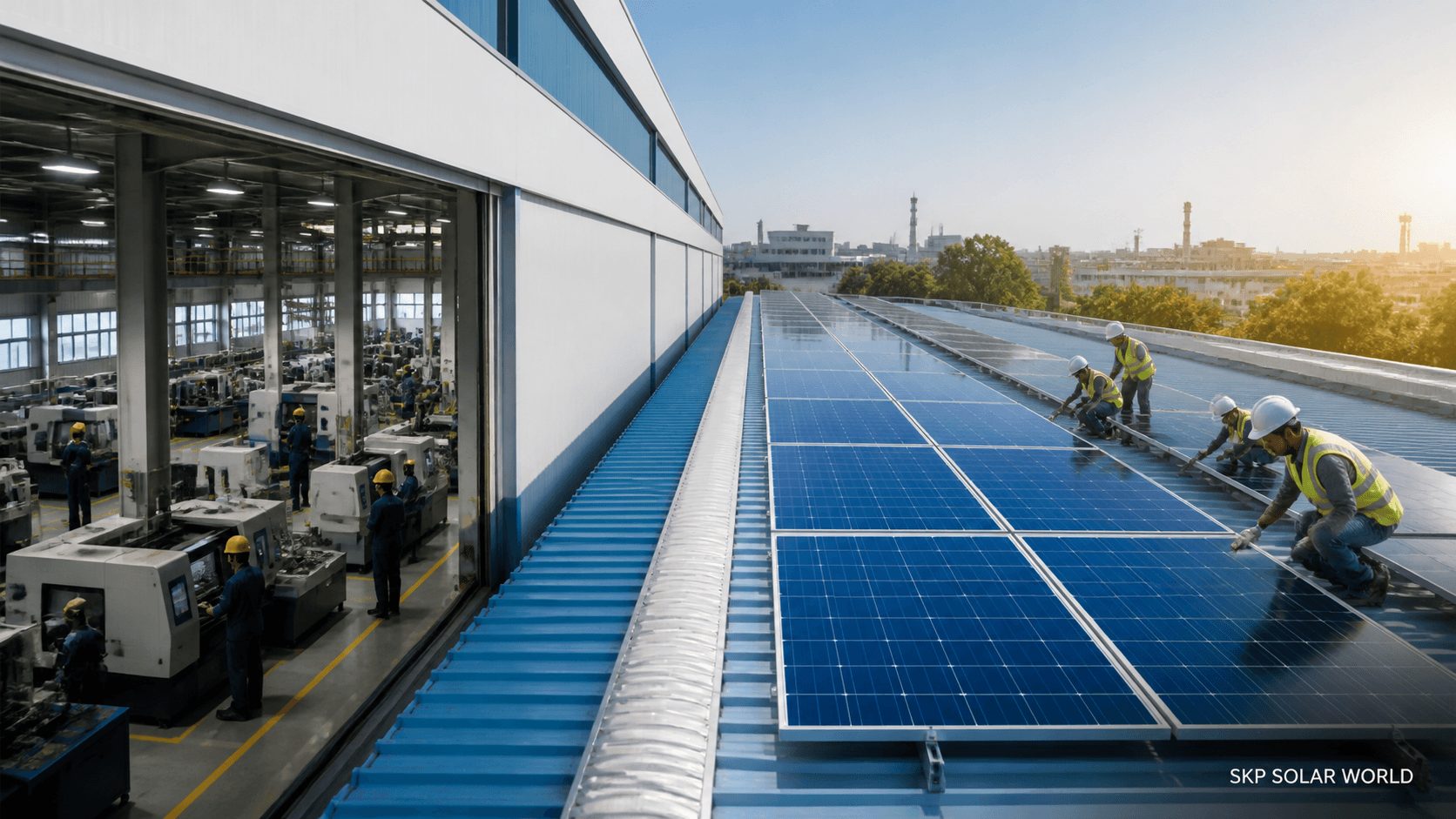 Industrial Solar
Rooftop Solar Installation for Factories: Will It Shut Down Your Production Line?
No. Installing rooftop solar on a factory or commercial building does not require shutting down production. The physical installation work, mounting panels, wiring, and connecting inverters, typically takes only 2 to 4 days and…
Read Article