
Rooftop Solar Installation for Factories: Will It Shut Down Your Production Line?
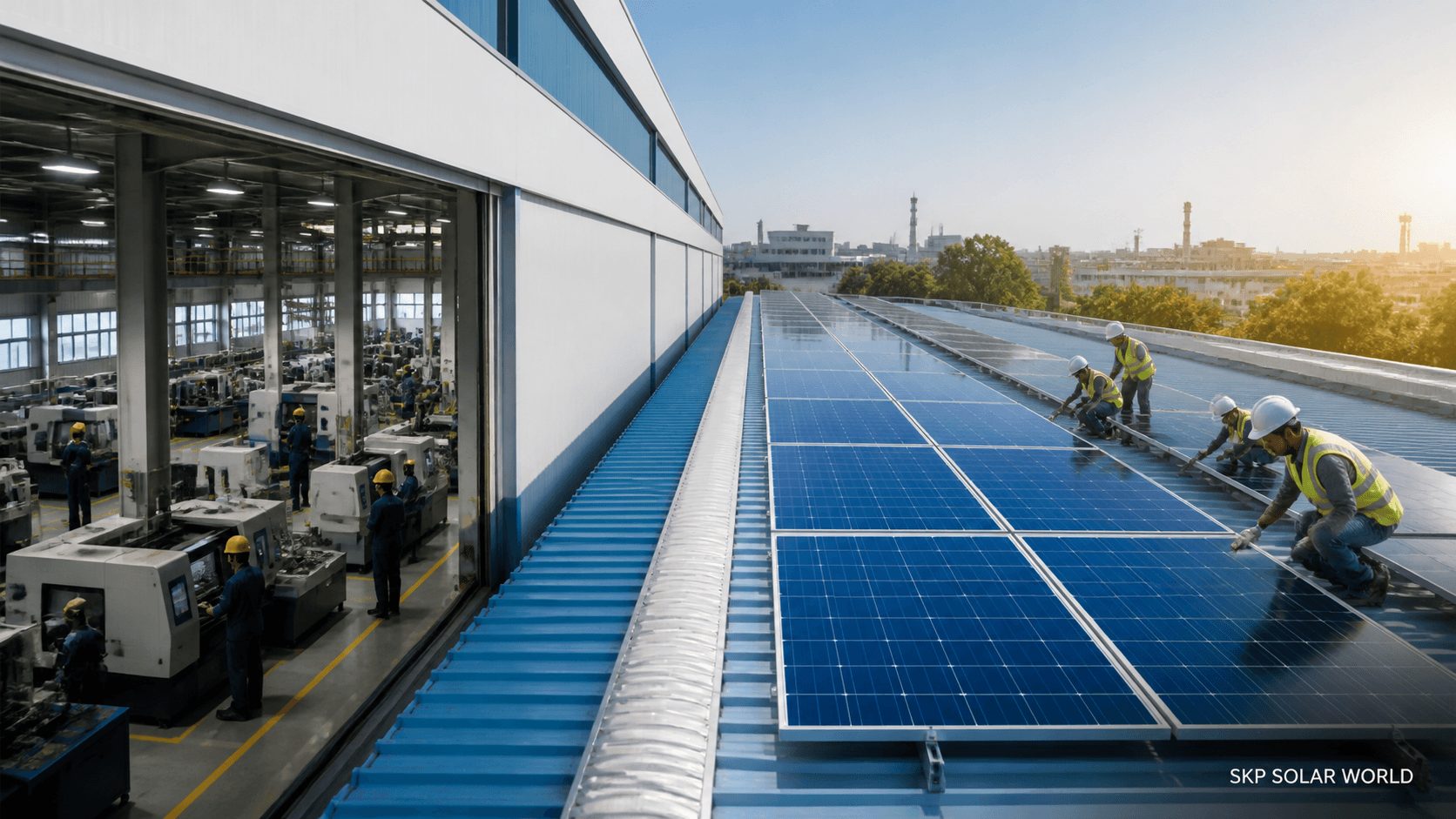
No. Installing rooftop solar on a factory or commercial building does not require shutting down production. The physical installation work, mounting panels, wiring, and connecting inverters, typically takes only 2 to 4 days and…
The hidden cost businesses are already paying
Commercial and industrial users consume roughly 49% of all electricity in India, yet only about 3.5% of the power this segment procures comes from renewable sources, according to IEEFA's analysis of India's commercial and industrial power mix. That gap is not accidental. It reflects years of factory and business owners assuming that solar power in India is a residential product, or worse, assuming that fitting it to an operating facility means losing production days.
The data says otherwise. India's rooftop solar capacity grew to 7.1 GW in calendar year 2025, more than double the 3.2 GW added in 2024, a 123% jump in a single year, according to Mercom India's Q4 2025 rooftop solar market report. Nationally, grid-connected rooftop capacity had reached 23.16 GW out of India's total 132.85 GW of installed solar capacity as of end November 2025, per figures released by the Ministry of New and Renewable Energy. Commercial and industrial rooftops are not a footnote in this growth either: IEEFA's dedicated study of India's C&I rooftop market found this segment already accounts for 70 to 80% of all rooftop installations nationwide, a pattern that sets India apart from many other countries where homeowners lead adoption.
Why factory owners still hesitate
If the economics are this favorable, why does a meaningful share of eligible facilities still sit without a single panel on the roof? The honest answer is operational anxiety, not financial doubt. Plant managers picture a shutdown similar to a major equipment retrofit: scaffolding across the roof, breaker panels dead for days, production lines idle while contractors work overhead. That mental model is understandable, and it is largely wrong for a modern photovoltaic rooftop system.
There is a second, quieter hesitation: financing and vendor risk. IEEFA's research on the sector notes that thin margins have pushed a number of smaller EPC (engineering, procurement, and construction) firms out of the market entirely, which in turn has left some completed installations without a company left to honor the warranty. That is a legitimate concern, and it belongs in the buying decision. It is a separate question from whether installation itself disrupts operations, and conflating the two is what keeps many otherwise-ready facilities on the sidelines.
What actually happens during an industrial rooftop installation
A rooftop solar project for a factory or commercial building generally moves through a sequence that looks like this:
- Site survey and structural assessment (roughly days 1 to 5): Engineers assess roof load capacity, shading, and usable area. No work touches the building's power supply at this stage.
- Design, contracting, and approvals (roughly days 5 to 30): This is usually the longest phase of the entire project. It involves the distribution company's technical feasibility review and the paperwork for net metering registration, none of which requires anyone on-site.
- Procurement (roughly days 25 to 35): Panels, inverters, mounting structures, and cabling are sourced and delivered. Again, the plant runs as normal.
- Physical installation (typically 2 to 4 days for a standard system, closer to 3 to 5 days for larger commercial-scale arrays): Mounting, wiring, and inverter placement happen on the roof or a dedicated ground area. This is the only phase that touches the building physically, and it can usually be scheduled around a weekend, a low-production shift, or a planned maintenance window rather than a weekday production run.
- Testing, commissioning, and DISCOM inspection (final stretch of the 60 to 90 day window): The grid tie-in requires a brief, coordinated isolation of the specific panel being connected, typically measured in hours, not days, and it is scheduled in advance rather than sprung on the facility.
The pattern that matters most for a business owner: the parts of the process that take the longest (feasibility approval, procurement, inspection) are exactly the parts that do not require anyone to be on-site or any equipment to go offline. The parts that do require physical work on the building are the shortest phases in the entire timeline.
Smarter criteria for evaluating an installation plan
Once a business owner understands that installation and disruption are not the same thing, the real question becomes how to judge whether a specific EPC provider has planned the physical work well. A stronger evaluation looks past the headline price and asks about sequencing, staffing, and contingency planning for the days when crews are actually on the roof.
What to look for before signing a contract
- A written installation schedule that names the specific days crews will be on-site, not just a total project duration.
- A plan to phase work by section of the roof or by electrical zone, so only the circuit being tied in is ever isolated, rather than the whole building.
- Weekend, off-shift, or planned-maintenance scheduling for any step that touches live wiring or requires a brief power isolation.
- A named site supervisor who coordinates directly with the facility's own maintenance or operations team, rather than leaving that communication to a project manager offsite.
- Documented structural and safety compliance for roof loading and electrical work, since this protects both the building and the people working on it.
- A clear post-installation monitoring and service commitment, given how many smaller EPC firms have exited the market and left customers without support.
Turning a well-planned installation into a straightforward decision
Once the operational risk is properly scoped, rooftop solar stops being a scheduling gamble and starts being what the underlying economics have suggested all along, a sound infrastructure investment. This is the point at which the right EPC partner matters more than any other single factor, because a provider that plans installation around your production calendar removes the last real objection standing between a facility and lower monthly power costs.
SKP Solar World designs, supplies, and installs rooftop solar systems for homes, businesses, and industrial facilities across India, and every industrial project starts with a site-specific schedule built around the client's actual production hours, not a generic template. You can request a facility assessment from SKP Solar World before committing to anything, which gives you a realistic installation window based on your roof, your load, and your operating calendar rather than a vendor's convenience.
For businesses that have already run the numbers on electricity costs but never checked how a rooftop system would actually be scheduled around their operations, that is usually the missing piece. It is worth asking a prospective EPC partner to walk through a proposed day-by-day installation plan before signing anything, and SKP Solar World provides that plan as a standard part of every industrial proposal.
The wider pattern in renewable energy adoption in India is moving in one clear direction: more capacity, faster growth, and a commercial and industrial segment that has the most to gain and the most catching up to do. Businesses that wait for a "convenient" quiet period to install solar are usually waiting for a moment that never quite arrives, while the monthly power bill keeps compounding in the meantime.
If your facility has been sitting on a solar decision because of scheduling concerns rather than financial ones, the most useful next step is a direct comparison: line up your current monthly electricity bill against a projected post-solar bill for your specific roof and load profile. You can compare your current electricity bill with your projected solar savings directly with SKP Solar World's team, alongside an installation plan that fits around your production schedule rather than against it, so you can see the actual numbers and the actual calendar before making any commitment.
Frequently asked questions
Does installing rooftop solar require shutting down my entire factory?
No. Standard practice isolates only the specific electrical panel being connected to the new solar system, and even that isolation is brief and scheduled in advance. The rest of the facility continues operating normally throughout installation.
How many days will contractors actually be on my roof?
For most commercial and industrial systems, physical installation work takes roughly 3 to 5 days, depending on system size and roof layout. This is separate from the longer 60 to 90 day project timeline, most of which is approval paperwork that does not involve any on-site work.
Can installation be scheduled around our production shifts?
Yes. A well-planned EPC provider will sequence roof work by section and schedule any step that touches live electrical circuits during weekends, off-shifts, or planned maintenance windows, so it does not interfere with a normal production day.
Why does the total project take 60 to 90 days if the physical work is so short?
Most of that time is DISCOM (electricity distribution company) feasibility review, net metering registration, and final inspection, none of which requires anyone to be present at the facility. The on-site installation itself is the shortest phase in the sequence.
What should we ask a solar EPC provider before signing a contract?
Ask for a written day-by-day installation schedule, confirmation that work will be phased by electrical zone rather than isolating the whole building, and a named site supervisor who will coordinate directly with your operations team.
Last updated: July 25, 2026
By Mr. Ravinder Pabla, Founder, SKP Solar World
Sources
- Mercom India: Rooftop Solar Growth Accelerates in India with 7.1 GW Added in 2025, a 123% YoY Jump
- pv magazine India: India Surpasses 132 GW of Installed Solar Capacity: MNRE
- IEEFA: The Rooftop Solar Commercial & Industrial Market in India
- IEEFA: Powering Up Sunshine, How India's Commercial and Industrial Sector Can Drive Rooftop Solar Power
- Heaven Green Energy: Solar Installation Timeline, Day-by-Day Process in India
Ready to Explore Solar for Your Property?
Model your own numbers in two minutes, or have an SKP engineer walk your roof and give you the conservative version.
You May Also Like
 Industrial Solar
Planning Power Capacity for Business Expansion: Rooftop Solar for Growing Indian Industries
A growing business needs more than new machinery and production capacity—it also needs a power plan that can scale with expansion. Rooftop solar helps industries reduce dependence on grid upgrades, control electricity costs, and add generation capacity in phases as demand grows. By planning solar alongside future load, roof availability, net metering, and open-access options, businesses can expand more efficiently and avoid costly power constraints later.
Read Article Industrial Solar
ESG and Sustainability Compliance for Indian Industrial Businesses
Solar is not only an energy-saving investment—it can also strengthen ESG compliance, improve sustainability credentials, support exporters and suppliers dealing with large companies, and reduce electricity costs at the same time. “Rooftop solar helps industries reduce energy costs today while building measurable ESG readiness for tomorrow.”
Read Article Industrial Solar
Planning Power Capacity for Business Expansion: Rooftop Solar for Growing Indian Industries
When a factory or business expands, electricity demand usually rises faster than the local grid connection can be upgraded. The practical fix is to plan power capacity in parallel with expansion, not after it. Rooftop solar…
Read Article