
Common Myths About Home Solar in India: What the Data Actually Shows

Monsoon shutdowns, high cost, fast degradation, impossible paperwork: the most common myths about home rooftop solar in India, checked against 2026 data from CEEW, MNRE, Mercom and PM Surya Ghar.
**Last updated: August 17, 2026**
**Quick answer:** The biggest myths about home rooftop [solar energy](https://en.wikipedia.org/wiki/Solar_energy) in India, that it barely works in monsoon, that it is only for the wealthy, that panels degrade fast, and that paperwork is impossible, do not hold up against current data. Panels lose only 10 to 20 percent output during monsoon rather than shutting down. A national study found 73 percent of households who call rooftop solar "expensive" are simply unaware of financing options. Manufacturers must now honor a 10-year product warranty and a 25-year performance warranty. And more than 24 lakh Indian households have already completed installation under a national subsidy scheme. The real barrier is not solar's performance. It is outdated information.
A quieter number behind India's rooftop solar boom
Residential rooftop installations made up 82 percent of all new rooftop [photovoltaic](https://en.wikipedia.org/wiki/Photovoltaics) capacity added in India in the first quarter of 2026, according to Mercom India data reported by [pv magazine India](https://www.pv-magazine-india.com/2026/05/29/residential-segment-accounts-for-82-of-indias-rooftop-solar-additions-in-q1-2026-mercom/). Cumulative rooftop solar capacity reached 23.5 GW by the end of March 2026, and quarter-on-quarter growth stood at 25 percent, with year-on-year growth at 125 percent. That is not a niche adoption curve. It is a market moving faster than the assumptions most homeowners are still working from.
Yet a large share of Indian households have not moved, not because the technology underperforms, but because the story in their head about [solar power in India](https://en.wikipedia.org/wiki/Solar_power_in_India) was formed years ago and never updated. A household-level study by the Council on Energy, Environment and Water (CEEW) found that while general awareness of solar technology rose from 50 percent in 2020 to 90 percent by 2026, specific awareness of residential rooftop solar sat at only 57 percent, and just 52 percent of those aware households knew a national subsidy scheme even existed. Awareness and accurate information are two different things, and the gap between them is where most hesitation lives.
Why misinformation is the real bottleneck, not the technology
The same CEEW research traced exactly where interested households drop out of the decision journey. Of households aware of rooftop solar, 26 percent considered adopting it, only 5 percent initiated an installation, and just 1.4 percent completed the process. Among those who were both aware and willing, 71 percent had still taken no first step. When the researchers looked at why, cost perception was the single largest distortion: 73 percent of households who believed rooftop solar was too expensive turned out to be simply unaware that financing options existed at all. This is a pattern worth sitting with if you are a homeowner weighing solar today. The hesitation is rarely about the panels. It is about second-hand assumptions, a neighbor's outdated story, a decade-old news article, a myth repeated so often it feels like fact. Below are the five myths that show up most often in homeowner conversations, checked against the current data.
Myth 1: Solar panels barely generate power during monsoon
This is the myth homeowners in high-rainfall states raise first, and it is also the easiest to correct with data. Analysis cited by [pv magazine India](https://www.pv-magazine-india.com/2025/10/10/solar-power-during-monsoons-busting-the-myth/) shows that solar panels typically see only a 10 to 20 percent reduction in output during monsoon conditions, not a shutdown. A well-designed system can still produce meaningful daily generation from diffused sunlight on overcast days. Weather-related variation, including cloud cover during monsoon months, accounted for only a 3 to 10 percent decline in solar irradiation across India in 2024 compared to long-term averages, according to Solargis data referenced in the same analysis. India also averages 250 to 300 sunny days a year, which is the backdrop monsoon dips are measured against, not the exception to it.
Myth 2: Rooftop solar is only realistic for wealthy homeowners
Cost is the myth doing the most damage to adoption, and the CEEW data is direct about why: the overwhelming majority of households who call solar "unaffordable" have not actually looked at what is available. Nearly three in four of them are unaware that financing options exist that remove the need for a large upfront payment. On top of that, the central government's PM Surya Ghar Muft Bijli Yojana has already reached scale, not as a pilot but as a functioning national program. According to figures shared in the Rajya Sabha and reported by [All India Radio's news service](https://www.newsonair.gov.in/over-24-lakh-households-installed-rooftop-solar-systems-under-pm-surya-ghar-scheme), 24 lakh households had completed rooftop solar installations under the scheme as of the reporting date, out of 53.54 lakh applications received on the national portal. Affordability today is a financing and awareness question, not a wealth question, and any credible quote a homeowner receives, inclusive of applicable GST on equipment and installation, should be weighed against the subsidy and financing support already built into the national program before it is dismissed as unaffordable.
Myth 3: Panels degrade quickly and stop performing within a few years
Homeowners who have seen an old, poorly maintained panel installation sometimes generalize that experience to the whole technology. The regulatory reality has moved past that. The Ministry of New and Renewable Energy now mandates a 10-year product warranty and a 25-year performance warranty for solar modules used in distributed renewable energy programs, as reported by [Mercom India](https://www.mercomindia.com/mnre-mandates-10-year-warranty-25-year-performance-cover-for-solar-modules). That is a quarter-century performance commitment written into the compliance requirement, not a marketing promise from an individual seller. Quality and degradation risk now sit largely with how a system is specified and installed, not with whether the underlying technology can last.
Myth 4: Net metering and government paperwork make solar impractical
Paperwork friction is a real, documented pain point, but it is a process problem, not a proof that the system does not work at scale. [Net metering](https://en.wikipedia.org/wiki/Net_metering), the mechanism that credits a household for surplus power exported back to the grid, has already been used successfully by millions of applicants nationally, evidenced by the 53.54 lakh applications received under PM Surya Ghar. The CEEW study found that among households who did start the adoption process, only 43 percent described the experience as smooth, with friction concentrated at application submission, vendor selection, and net metering approval. That is a real finding, and it points to a genuine buying criterion: the process is manageable, but only when the installer actually owns the paperwork and approval steps on the homeowner's behalf, rather than leaving them to navigate a DISCOM process alone.
Myth 5: Home solar adoption in India is still rare
This myth is simply out of date. India's total installed solar capacity reached 150.26 GW as of March 31, 2026, part of a broader renewable energy base of 274.68 GW that helped the country become the third-largest holder of installed [renewable energy](https://en.wikipedia.org/wiki/Renewable_energy_in_India) capacity globally, according to IRENA data cited in a Press Information Bureau release. Within that, residential rooftop solar is now the fastest-growing segment of the rooftop market, not a fringe category. The direction of the data is unambiguous: home solar has moved from early adoption to mainstream infrastructure.
What this means for how you should actually evaluate a home solar decision
Once the myths are set aside, the real decision comes down to a smaller set of questions than most homeowners expect. A well-informed buyer today is not asking "does solar work in my area." They are asking sharper, more useful questions:
- Is the system sized to my household's actual consumption pattern, not a generic rooftop package?
- Does the generation estimate account honestly for monsoon and seasonal variation, rather than an optimistic best-case number?
- Is the panel warranty backed by the manufacturer's documented terms, matching the 10-year product and 25-year performance standard?
- Who is actually managing the net metering application and DISCOM approval, and how much of that burden falls on me?
- What ongoing support exists after installation, for monitoring, cleaning guidance, and warranty claims?
A short checklist before you sign anything
- Ask for a site-specific generation estimate, not a generic per-kW figure copied across customers.
- Confirm in writing who files the net metering paperwork and tracks DISCOM approval timelines.
- Verify panel and inverter warranty terms match current MNRE-mandated minimums.
- Ask how the system performs on cloudy and monsoon days specifically, and request real generation data if available, not projections alone.
- Check whether financing or subsidy eligibility under PM Surya Ghar has already been factored into the quoted cost.
This is precisely the gap SKP Solar World was built to close. As a rooftop solar EPC provider designing, supplying, and installing systems for homes, businesses, and industrial facilities across India, the team's role is to replace assumptions with a site-specific answer: how much your roof can realistically generate, how financing and subsidy eligibility apply to your household, and what a 25-year-backed system actually looks like for your specific consumption pattern. You can [see how a right-sized home solar system is designed for your roof](https://skpsolarworld.com/) before committing to anything.
If cost perception is the biggest myth holding you back, the fastest way to test it is with your own numbers rather than a general estimate. SKP Solar World's team can help you [compare your current electricity bill with a projected solar savings estimate](https://skpsolarworld.com/), so the affordability question gets answered with your actual DISCOM bill instead of a rumor. For households still unsure about paperwork or net metering approvals, it also helps to [get a transparent, no-obligation site assessment](https://skpsolarworld.com/) that spells out exactly who handles what.
None of this requires a large upfront commitment to explore. If you have been holding off on rooftop solar because of something you heard rather than something you checked, it is worth spending fifteen minutes to [check your home's solar eligibility and financing options with SKP Solar World](https://skpsolarworld.com/) and see what the numbers actually say about your roof, your bill, and your household.
Frequently asked questions
Do solar panels really stop working during monsoon season in India?
No. Data cited by pv magazine India shows panels typically see only a 10 to 20 percent reduction in output during monsoon conditions, and continue generating from diffused sunlight even on cloudy days. They do not shut down.
Is rooftop solar only affordable for wealthy homeowners?
No. National research from CEEW found that 73 percent of households who perceive rooftop solar as expensive are unaware that financing options already exist. Combined with the central government's PM Surya Ghar scheme, which has supported over 24 lakh household installations, affordability barriers are often informational rather than financial.
How long do home solar panels actually last before performance drops significantly?
The Ministry of New and Renewable Energy mandates a 10-year product warranty and a 25-year performance warranty on solar modules, meaning manufacturers are compliance-bound to a quarter-century performance commitment rather than a short usable life.
Is net metering too complicated for an average homeowner to manage alone?
It can be, if a homeowner is left to navigate DISCOM approvals independently. National data shows only 43 percent of households who started the adoption process found it smooth, with friction concentrated at application and approval stages. Choosing an installer who manages the net metering paperwork directly removes most of this friction.
Is home solar adoption still uncommon in India in 2026?
No. Residential rooftop solar made up 82 percent of all new rooftop solar capacity added in India in the first quarter of 2026, and India's total solar capacity passed 150 GW by March 2026, making the country the third-largest holder of installed renewable energy capacity globally.
Sources
- [Council on Energy, Environment and Water: What Shapes Rooftop Solar Decisions in Indian Households](https://www.ceew.in/publications/what-shapes-rooftop-solar-decisions-in-indian-households)
- [All India Radio (Newsonair): Over 24 Lakh Households Installed Rooftop Solar Systems Under PM Surya Ghar Scheme](https://www.newsonair.gov.in/over-24-lakh-households-installed-rooftop-solar-systems-under-pm-surya-ghar-scheme)
- [pv magazine India: Residential Segment Accounts for 82% of India's Rooftop Solar Additions in Q1 2026 (Mercom)](https://www.pv-magazine-india.com/2026/05/29/residential-segment-accounts-for-82-of-indias-rooftop-solar-additions-in-q1-2026-mercom/)
- [pv magazine India: Solar Power During Monsoons, Busting the Myth](https://www.pv-magazine-india.com/2025/10/10/solar-power-during-monsoons-busting-the-myth/)
- [Mercom India: MNRE Mandates 10-Year Warranty, 25-Year Performance Cover for Solar Modules](https://www.mercomindia.com/mnre-mandates-10-year-warranty-25-year-performance-cover-for-solar-modules)
- [Press Information Bureau, Government of India: India Ranks Third Globally in Renewable Energy Installed Capacity](https://www.pib.gov.in/PressReleasePage.aspx?PRID=2250039&lang=1®=3)
Ready to Explore Solar for Your Property?
Model your own numbers in two minutes, or have an SKP engineer walk your roof and give you the conservative version.
You May Also Like
 Residential Solar
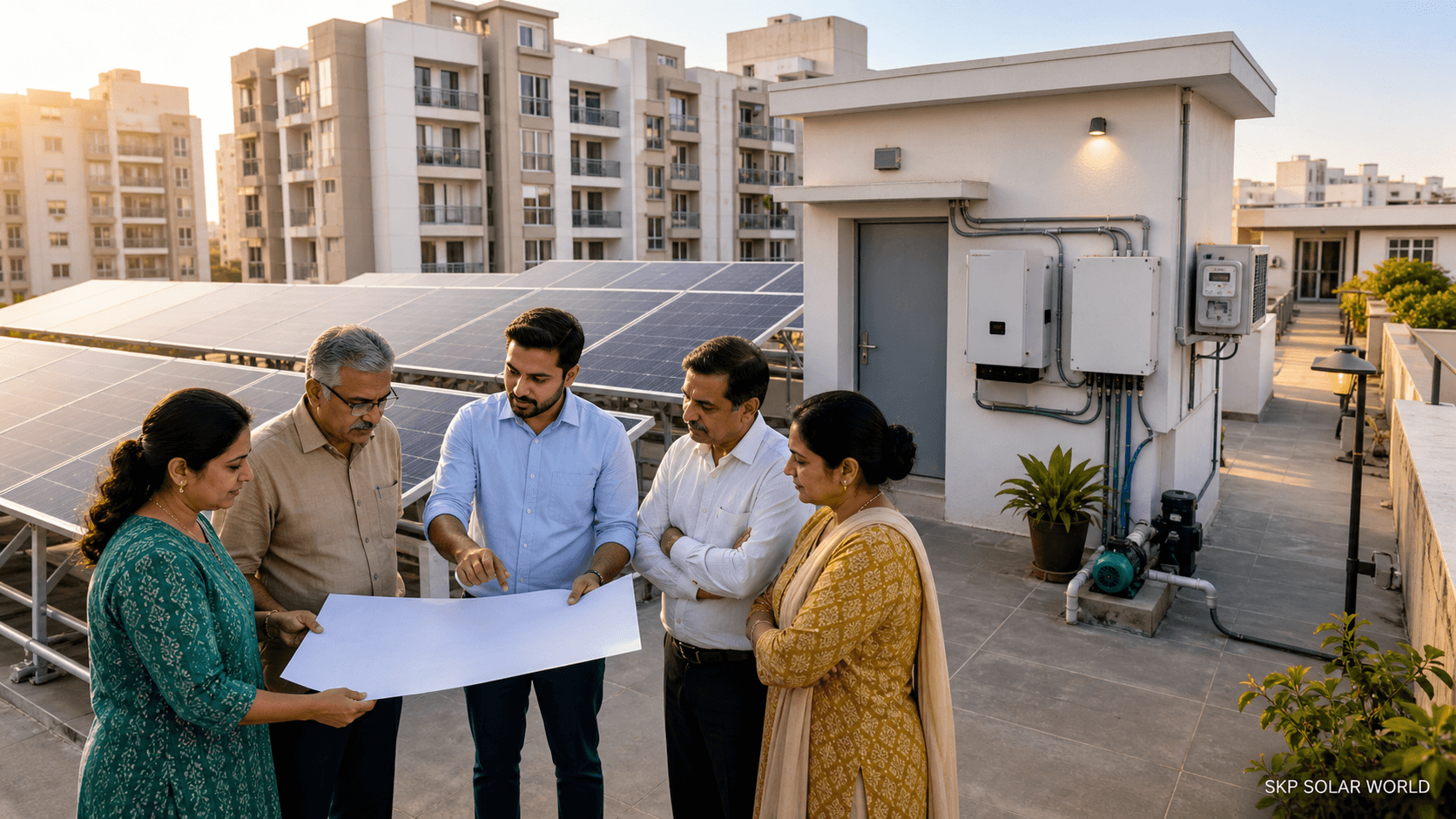
Solar for Apartments and Housing Societies in India: Making Shared Rooftops Work for Every Resident
Yes, apartment complexes and housing societies in India can install rooftop solar for shared spaces such as lifts, water pumps, corridors, and common lighting, using a mechanism called group net metering.
Read Article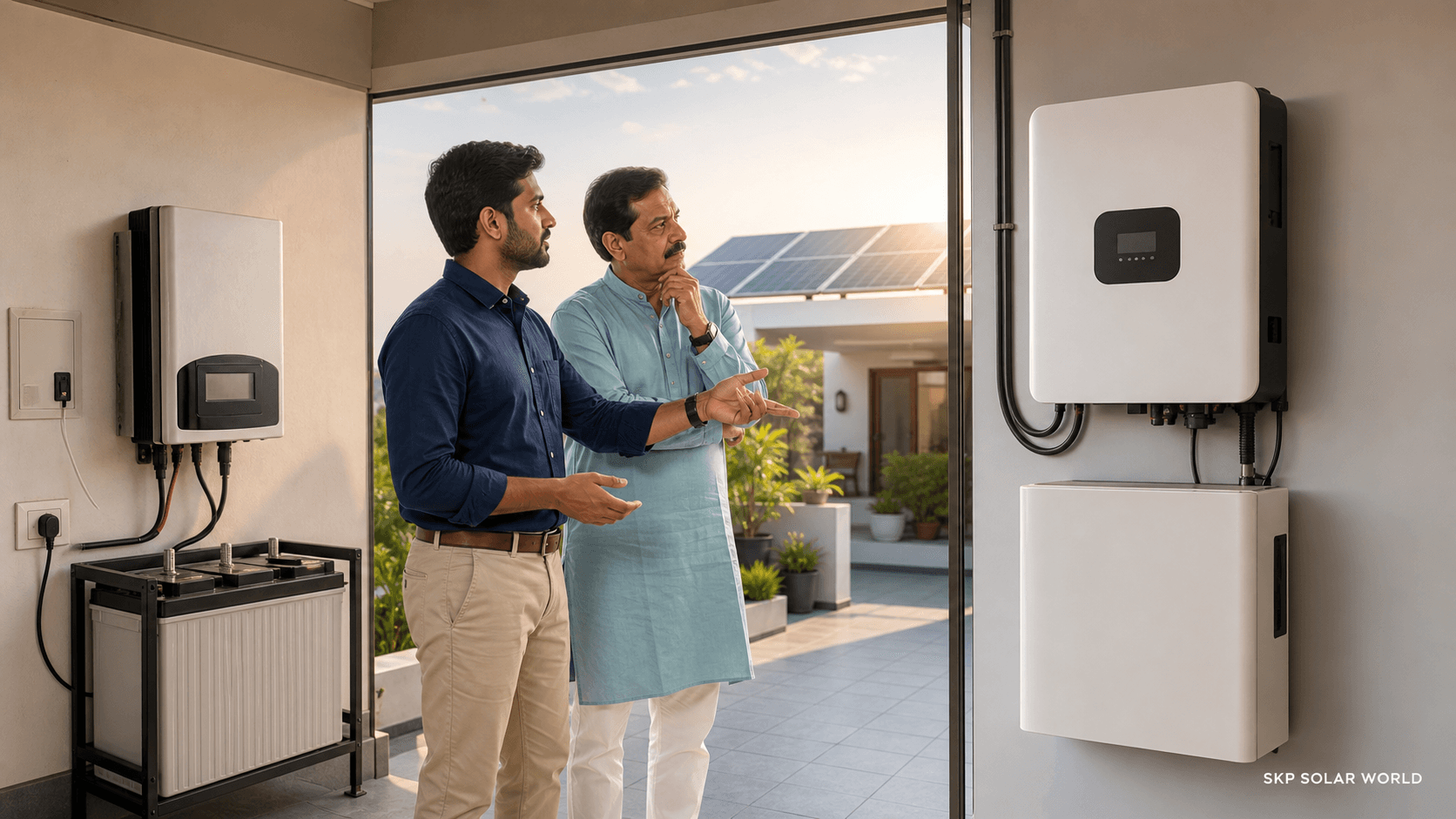 Residential Solar
Solar With Battery Backup vs a Traditional Home Inverter in India: What Actually Pays Off
A solar system with battery backup replaces the electricity itself, generating and storing your own power during the day for use after sunset or during an outage, while a traditional inverter only stores grid electricity you have already paid for.
Read Article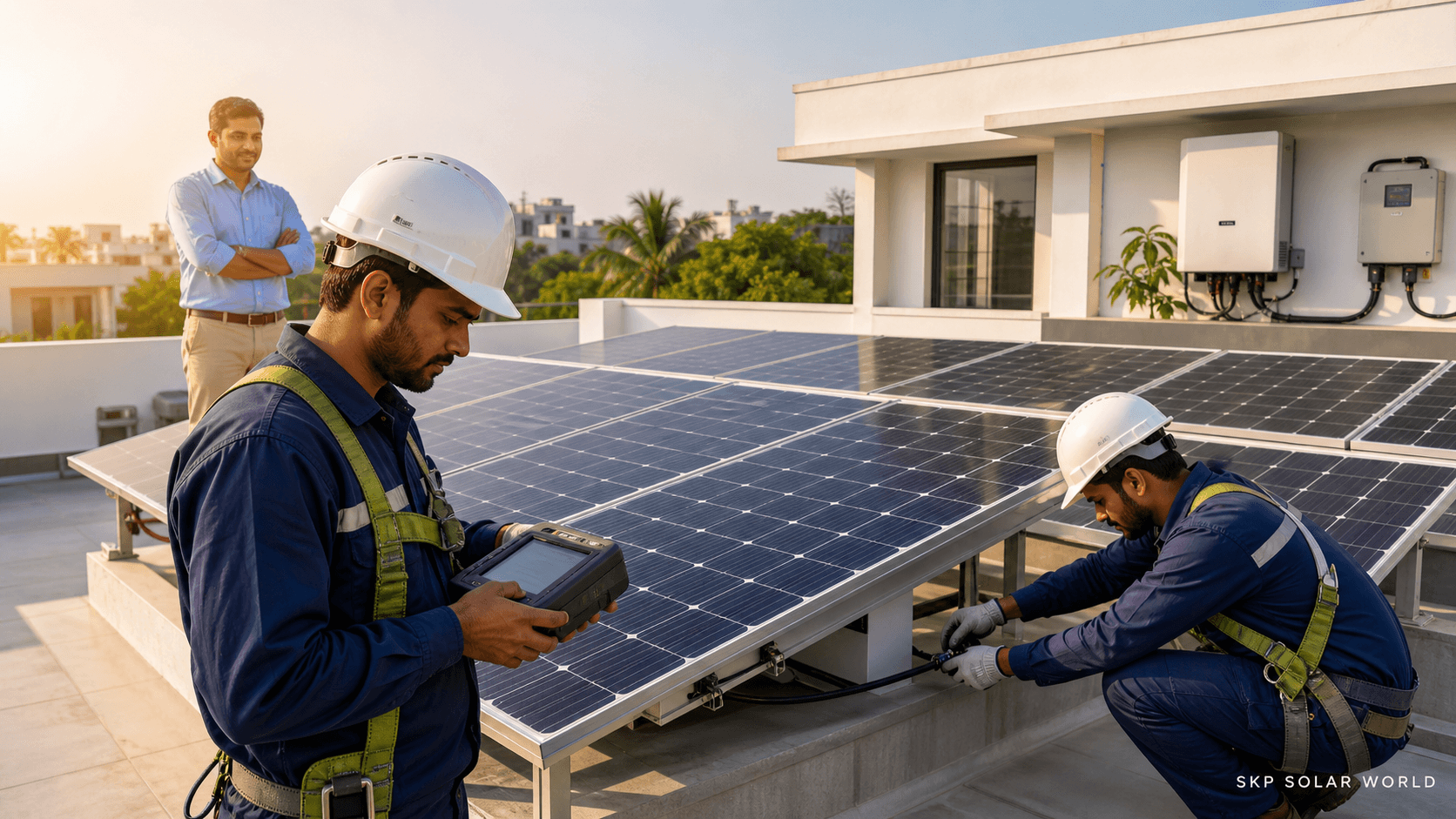 Residential Solar
How Long Does Home Rooftop Solar Installation Really Take in India?
A straightforward home rooftop solar installation in India typically takes 3 to 6 weeks from signed agreement to a working, grid-connected meter, though the on-roof mounting and wiring itself is usually finished within 1 to 3 days.
Read Article