
Solar With Battery Backup vs a Traditional Home Inverter in India: What Actually Pays Off
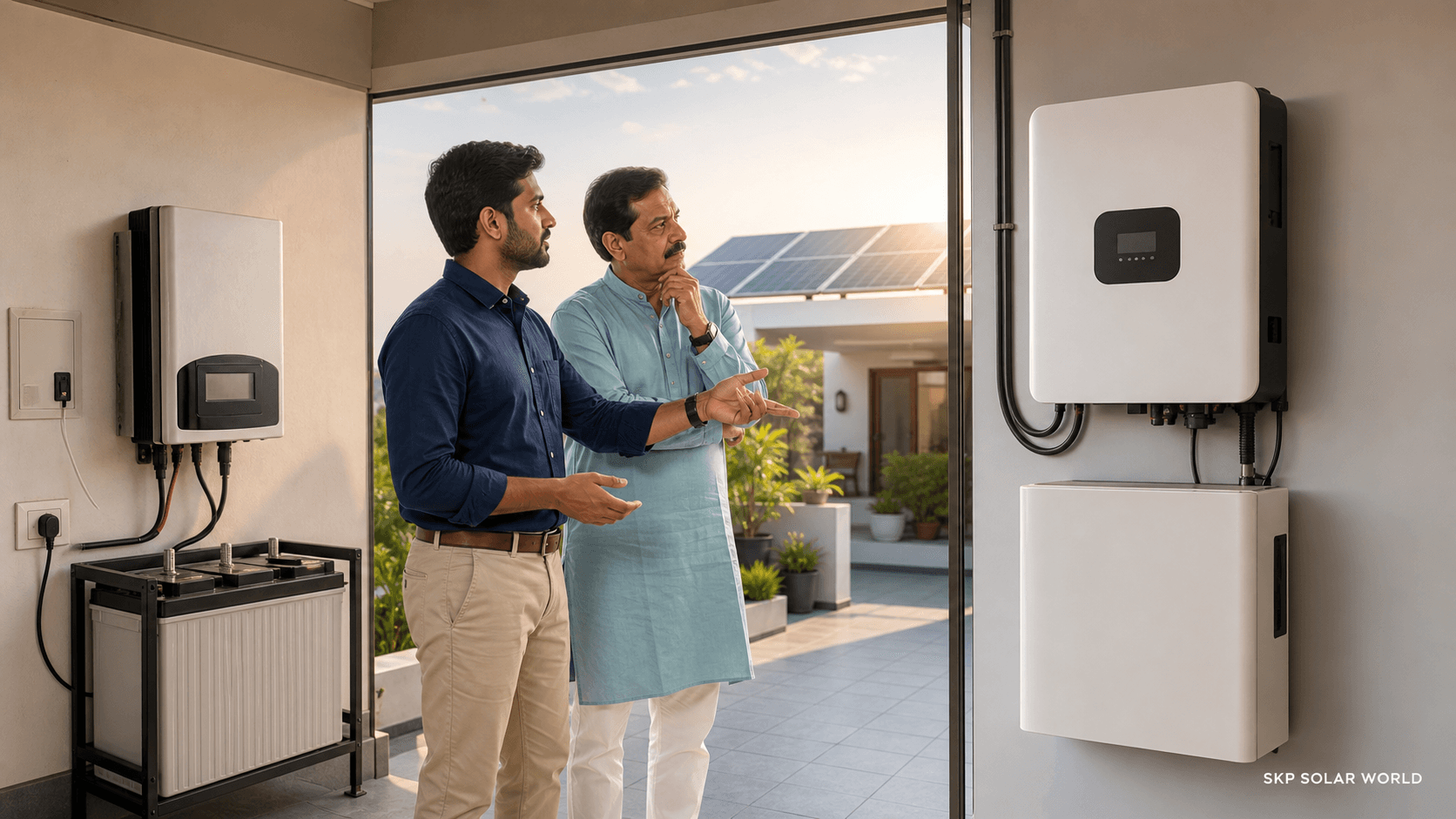
A solar system with battery backup replaces the electricity itself, generating and storing your own power during the day for use after sunset or during an outage, while a traditional inverter only stores grid electricity you have already paid for.
Why So Many Indian Homes Still Keep a Backup Plan
India's power grid has genuinely improved. National average power availability has climbed from roughly 12.5 hours a day in rural areas in 2014 to 22.6 hours a day in 2025, while urban households now see around 23.4 hours of daily supply, according to the Ministry of Power's year end review. Nationally, energy shortages have fallen to a mere 0.03 percent in FY 2025-26, down from 4.2 percent in FY 2013-14.
That is a genuine transformation. But it also means something easy to miss: even in a well-supplied urban home, the grid is still absent for roughly half an hour to an hour on an average day, and in many rural and semi-urban pockets the gap remains wider, often concentrated in early morning or evening hours when the household needs power most. That residual gap is exactly why the humble home inverter has stayed a fixture in Indian households for two decades, and why the backup conversation is shifting toward solar power in India as a way to cover that gap without simply storing electricity bought at retail rates.
The Hidden, Recurring Cost of a Traditional Inverter
A standard inverter and lead-acid battery setup looks inexpensive on day one. The real cost shows up later. Lead-acid inverter batteries typically need replacement every 3 to 4 years, and each replacement is a fresh, undiscounted expense, on top of the electricity the battery is charged with in the first place, which is regular grid power billed at your existing tariff slab, GST included where applicable on the equipment and service charges. Homeowners rarely add up these repeat costs over a 10 or 15 year horizon, but they compound: buy a battery, run it down through daily charge cycles, watch backup time shrink as it ages, then replace it and start again.
A rechargeable battery paired with rooftop solar works on a different principle. Instead of storing electricity you paid the DISCOM for, it stores electricity your own panels generated for close to zero marginal cost once the system is installed. The backup function is the same, keeping lights, fans, and essential appliances running through an outage, but the electricity behind it is self-generated rather than purchased twice.
How a Solar Plus Battery System Actually Works
A hybrid rooftop solar system uses a hybrid inverter that can do three things a plain grid-tied solar inverter cannot: charge a battery from solar generation during the day, draw from that battery during an outage, and still export any genuine surplus to the grid under your state's net metering arrangement when the battery is full. This is a meaningfully different architecture from a grid-tied solar system without storage, which shuts down automatically during a grid outage for safety reasons and cannot power your home when the grid is down, regardless of how sunny the day is.
Battery economics have also shifted in the homeowner's favour. Battery cell costs globally have fallen by roughly 89 percent since 2010, moving toward the 100 US dollar per kilowatt-hour mark by 2025, a decline that has made pairing storage with rooftop solar considerably more viable than it was even five years ago. That price trend is a large part of why solar-plus-battery is now being discussed as a mainstream home backup option rather than a premium, early-adopter purchase.
What Smart Buyers Now Look For Before Choosing a Backup Solution
Once a household understands the real cost gap between recurring inverter battery replacement and one-time solar-plus-battery investment, the buying question changes. It stops being "which is cheaper today" and becomes "which decision protects us from rising tariffs and repeat costs over the next decade." A few criteria consistently separate a good decision from a regretted one:
- Actual outage pattern, not assumptions: a household with rare, short outages may be well served by solar alone under net metering, while frequent or long outages justify the added cost of battery storage.
- Correct system and battery sizing: undersized batteries drain fast and disappoint during longer cuts, while oversized ones waste money that could have gone toward a larger solar array.
- Component transparency: the brand and specification of the battery, hybrid inverter, and panels should be disclosed in writing, not described only in general terms during a sales conversation.
- Roof and shading realities: orientation, shading through the day, and available roof area all affect how much of the household's backup and daytime load solar can realistically cover.
- Subsidy and paperwork support: under the PM Surya Ghar Muft Bijli Yojana, homes can currently receive central assistance of roughly ₹30,000 for a 1 kW system, ₹60,000 for 2 kW, and up to ₹78,000 for systems of 3 kW and above, and a capable installer should handle this documentation rather than leaving it to the homeowner.
A Short Checklist Before You Sign Anything
- Ask for the exact battery chemistry, warranty period, and expected cycle life in writing.
- Confirm whether the quoted price is a complete, GST-inclusive figure or has add-ons pending.
- Check whether the system design supports adding battery storage later if you start with solar alone.
- Verify net metering eligibility and application support with your local DISCOM before installation.
- Request a load and outage assessment specific to your home, not a generic package size.
Where This Fits Into Your Decision
This is the kind of decision that benefits from a proper load and roof assessment rather than a generic quote, which is the starting point our team at SKP Solar World uses with every homeowner. As a rooftop solar EPC company handling design, supply, and installation for homes, businesses, and industrial facilities across India, SKP Solar World's rooftop solar and battery backup planning process begins by mapping your actual outage pattern and daily consumption before recommending solar-only or solar-plus-battery, rather than defaulting to the more expensive option.
If your household is still deciding between renewing an ageing inverter battery and moving to rooftop solar with storage, it is worth putting real numbers side by side. You can compare your current electricity bill with your projected solar savings before committing to either path, and if backup during outages is the main concern, our team can walk through a home-specific solar and battery sizing assessment so the system matches your roof, your load, and your budget rather than a standard package.
There is no obligation in getting that comparison done. If the numbers make sense for your home, you will know clearly; if they do not, you will know that too, and either way you will be deciding from real data rather than a sales estimate. Reach out through SKP Solar World to get that assessment started for your home.
Frequently Asked Questions
Is solar with battery backup always better than a traditional inverter for home power cuts?
Not always. If your home experiences only occasional, short outages and your primary goal is reducing your electricity bill, grid-tied solar without a battery, supported by net metering, may deliver most of the savings at a lower upfront cost. Battery backup earns its extra cost mainly in homes with frequent or lengthy outages, or where the household wants power during a cut regardless of time of day.
How long does a solar battery last compared to a standard inverter battery?
A typical lead-acid inverter battery lasts around 3 to 4 years before it needs replacement. Batteries designed for solar backup systems, particularly lithium-based ones, are generally rated for a longer cycle life, which is why the total cost of ownership over 10 to 15 years often favours the solar-plus-battery route despite the higher initial price.
Can I install solar now and add a battery later?
In many cases yes, provided the system is designed with future battery addition in mind from the start, including a hybrid-capable inverter or space and wiring provisioned for one. This is a design decision worth confirming with your installer before installation, since retrofitting a system that was not planned for storage can cost more than including that flexibility upfront.
Does a solar plus battery system still work at night or during a cloudy day?
Yes. The battery stores energy generated during sunlight hours and discharges it at night or whenever the grid is down or generation is low, which is precisely the function a traditional inverter battery performs, except the battery is charged by your own solar generation rather than purchased grid electricity whenever there is sufficient daytime output.
Does adding a battery affect my net metering benefits?
A correctly designed hybrid system can still export genuine surplus power to the grid under net metering after the battery is charged, so battery storage and net metering are not mutually exclusive. The exact rules on export limits and battery-plus-net-metering configurations vary by state and DISCOM, so it is worth confirming local policy before finalising your system design.
Sources
- Ministry of Power, Government of India: India's Power Sector: Progress, Reform, and the Road Ahead (PIB, March 2026)
- India Brand Equity Foundation: PM Surya Ghar Muft Bijli Yojana subsidy and household statistics
- Renewable Energy Asia Portal (Ember): Battery storage cost trends and solar potential in India
Ready to Explore Solar for Your Property?
Model your own numbers in two minutes, or have an SKP engineer walk your roof and give you the conservative version.
You May Also Like
 Residential Solar
Common Myths About Home Solar in India: What the Data Actually Shows
Monsoon shutdowns, high cost, fast degradation, impossible paperwork: the most common myths about home rooftop solar in India, checked against 2026 data from CEEW, MNRE, Mercom and PM Surya Ghar.
Read Article Residential Solar
Solar for Apartments and Housing Societies in India: Making Shared Rooftops Work for Every Resident
Yes, apartment complexes and housing societies in India can install rooftop solar for shared spaces such as lifts, water pumps, corridors, and common lighting, using a mechanism called group net metering.
Read Article Residential Solar
How Long Does Home Rooftop Solar Installation Really Take in India?
A straightforward home rooftop solar installation in India typically takes 3 to 6 weeks from signed agreement to a working, grid-connected meter, though the on-roof mounting and wiring itself is usually finished within 1 to 3 days.
Read Article