
Solar for Apartments and Housing Societies in India: Making Shared Rooftops Work for Every Resident
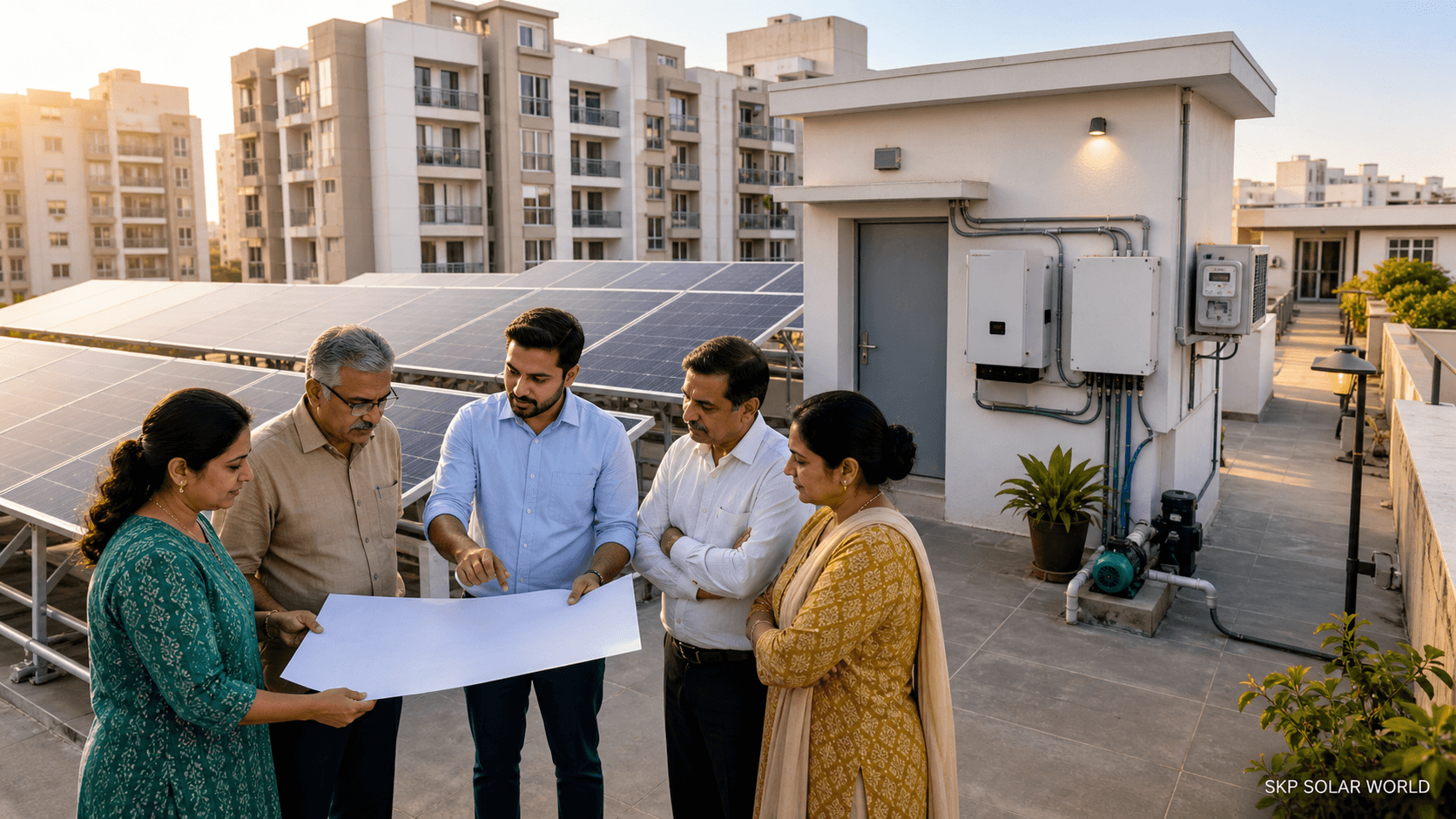
Yes, apartment complexes and housing societies in India can install rooftop solar for shared spaces such as lifts, water pumps, corridors, and common lighting, using a mechanism called group net metering.
Why the common-area electricity bill deserves more attention
Most conversations about home solar in India focus on individual rooftops. But a large share of the country's electricity demand for households actually lives in shared spaces: stairwell lighting, lift motors, borewell and overhead-tank pumps, security cabins, clubhouse loads, and common-corridor fittings. For a mid-sized apartment complex, these loads routinely account for a significant share of the society's total spend, and industry estimates put electricity at close to 40 percent of a typical housing society's recurring operating expenses.
India's solar power sector has expanded fast enough that this is no longer a niche idea. The Ministry of New and Renewable Energy (MNRE) reports that India's cumulative grid-connected rooftop solar capacity reached 30.74 GW by July 31, 2026, within a total installed solar base of 164.59 GW. Separately, the government's PM Surya Ghar Muft Bijli Yojana scheme had recorded over 26.19 lakh rooftop installations nationwide and disbursed roughly ₹17,967.53 crore in central financial assistance as of March 19, 2026. Most of that growth, however, has gone to single-owner homes and businesses. Multi-owner buildings have been slower to convert, not because the economics are weaker, but because the decision-making and paperwork are more complicated.
What actually makes housing society solar harder than home solar
A housing society is not a single customer in the eyes of a distribution company (DISCOM). It is a building with one common-area electricity connection, dozens or hundreds of individual flat connections, and a managing committee that has to represent everyone's interests before signing anything. That structure creates a specific set of obstacles that a single homeowner never has to deal with:
- Shared roof, shared decision. No single resident owns the terrace outright, so any solar proposal needs collective approval, not just one signature.
- Consumer category confusion. A society's common-area connection is frequently billed as a commercial or non-domestic connection rather than a residential one, which affects both tariff rates and subsidy eligibility.
- Approval sequencing. A general body resolution, individual flat-owner no-objection certificates, and DISCOM feasibility clearance typically all have to line up before installation can start.
- Structural sign-off. Terraces on older buildings need a structural check before any array is mounted, especially where water tanks or existing equipment already load the roof.
None of these are dealbreakers. They are simply steps that a competent EPC (engineering, procurement, and construction) partner should already know how to sequence.
How group and virtual net metering actually work
Net metering is the billing arrangement that lets a solar system's owner export surplus electricity to the grid and receive credit against future consumption. For a single home, this is a straightforward one-meter, one-system relationship. For a housing society, regulators have had to build two variations that fit a building with many connections:
Group net metering (GNM)
One rooftop solar installation feeds credits across multiple meters belonging to the same legal entity, most commonly the society's own common-area connections (lift, pump, lighting). This is the most widely used model for common-area solar today and is explicitly enabled under the CERC 2022 regulatory amendment, with state-level orders since issued in Gujarat, Maharashtra, and Rajasthan.
Virtual net metering (VNM)
Generation credits from a single rooftop system are algorithmically allocated across multiple, separately billed accounts, potentially including individual flats rather than only common areas. Maharashtra's electricity regulator (MERC) formalized VNM for multi-story buildings through a 2024 amendment, and Karnataka's regulator (KERC) has issued an order permitting apartment associations to use shared rooftop structures for solar generation.
Both models sit within India's broader renewable energy policy push, but availability and exact rules still vary by state and by DISCOM, which is precisely why a society's first conversation should be with an installer who already knows the local regulatory position rather than a generic national one.
What a smart RWA should evaluate before approving a proposal
Once a managing committee decides solar is worth pursuing, the buying decision shifts from "should we do this" to "who do we trust to do this correctly." A few criteria separate a proposal that performs from one that creates years of disputes:
- Correct system sizing against common-area load, not against the whole roof. Oversizing for a category that may not qualify for full net-metering credit wastes capital; undersizing leaves savings on the table.
- Clarity on consumer category and subsidy eligibility. A vendor should be able to explain, in writing, whether the society's common-area connection is likely to be classified as domestic or commercial for subsidy purposes, since that materially changes the financial case.
- A documented approval roadmap. General body resolution, flat-owner NOCs, and DISCOM feasibility approval should be laid out as a timeline with named responsibilities, not left as a vague "we'll handle it."
- Structural assessment before contract signing, not after the panels arrive on site.
- Transparent, itemized GST treatment. When purchased as a complete turnkey package (panels, inverter, mounting, cabling, and installation) from a single vendor, a rooftop photovoltaic system currently attracts a concessional 5 percent GST rate as a composite supply. If components are billed separately, panels and inverters can attract 12 percent and installation labor or mounting hardware can attract 18 percent, so societies should ask for the GST breakup in writing before comparing quotes.
A short checklist before signing
- Has the installer shared 12 months of common-area consumption data used for sizing, not just a rooftop area estimate?
- Is the net-metering model (group or virtual) confirmed with the local DISCOM in writing, not assumed?
- Does the quote separate equipment cost, installation cost, and GST line by line?
- Is there a single named point of contact for the society through construction and commissioning?
- What is the warranty structure for panels, inverter, and workmanship, and who services it locally?
A society that works through this list before signing avoids the two most common complaints RWAs raise after a bad installation: an undersized system that never delivers the promised bill cut, and a vendor who disappears once the subsidy paperwork gets complicated.
Where SKP Solar World fits into this decision
SKP Solar World designs, supplies, and installs rooftop solar EPC systems for homes, businesses, and industrial facilities across India, including common-area and shared-rooftop systems for apartment complexes and housing societies. Because every society's consumer category, roof condition, and DISCOM rules differ, the practical next step is usually a proper feasibility check rather than a generic quote. Managing committees can compare their society's current common-area electricity bill against a projected solar savings estimate before taking a proposal to the general body.
For societies still deciding between group net metering and virtual net metering, it helps to get a written explanation of which model applies to your specific DISCOM and building type, since assumptions carried over from a neighboring society's setup do not always transfer. And where structural sign-off or subsidy classification is the sticking point, a direct site assessment from SKP Solar World's rooftop solar EPC team is generally faster than trying to resolve it over email with the DISCOM.
If your society's managing committee is weighing a solar proposal, the simplest starting point is a side-by-side look at what you are paying today versus what a correctly sized common-area system could save. You can request a customized rooftop solar assessment for your housing society at skpsolarworld.com and use the numbers in your next general body meeting.
Frequently asked questions
Can an individual flat owner install solar without the society's approval?
Generally no, if the installation requires access to the shared terrace or common rooftop structure, since that space is jointly owned. A flat owner can sometimes install a small system on a private balcony or exclusive-use area, but any rooftop-level installation needs a general body resolution and, in most cases, a builder or society no-objection certificate.
Does a housing society need a separate electricity connection for solar?
No new connection is typically required. The solar system is connected to the society's existing common-area meter (or meters, under group net metering), and the DISCOM installs a bidirectional meter to measure both consumption and export.
Will solar cover 100 percent of a society's common-area electricity bill?
Rarely, and that is usually not the goal. Sizing is typically targeted at a high share of common-area consumption, since oversizing relative to what net-metering rules allow for that consumer category can reduce the financial return rather than improve it. Industry figures put realistic common-area bill reductions in the 50 to 80 percent range depending on roof area, shading, and local regulations.
Is the PM Surya Ghar subsidy available to housing societies?
It depends on how the common-area connection is classified. The scheme's subsidy structure is built around domestic consumers, and many large societies' common-area connections are billed as commercial, which can affect eligibility. This is exactly the kind of detail a society should confirm in writing with its installer before assuming a subsidy amount in its cost projections.
How long does approval and installation actually take for a society?
DISCOM feasibility approval commonly takes around two months, and physical construction for a typical society-scale system runs roughly 45 to 60 days once approved. Subsidy disbursement, where applicable, can take an additional two to six months depending on the state's processing timelines.
Sources
- Ministry of New and Renewable Energy: Physical Progress data
- SolarQuarter: PM Surya Ghar Yojana Updates 2026
- Heaven Green Energy: Solar for Housing Society India, Group Net Metering Guide
- SolarSquare: Solar for Apartment Buildings, Technical and Legal Checklist for RWAs
- Tristar Energy: Solar GST Rate 2026, 5 Percent on Panels, Inverters and Work
Ready to Explore Solar for Your Property?
Model your own numbers in two minutes, or have an SKP engineer walk your roof and give you the conservative version.
You May Also Like
 Residential Solar
Common Myths About Home Solar in India: What the Data Actually Shows
Monsoon shutdowns, high cost, fast degradation, impossible paperwork: the most common myths about home rooftop solar in India, checked against 2026 data from CEEW, MNRE, Mercom and PM Surya Ghar.
Read Article Residential Solar
Solar With Battery Backup vs a Traditional Home Inverter in India: What Actually Pays Off
A solar system with battery backup replaces the electricity itself, generating and storing your own power during the day for use after sunset or during an outage, while a traditional inverter only stores grid electricity you have already paid for.
Read Article Residential Solar
How Long Does Home Rooftop Solar Installation Really Take in India?
A straightforward home rooftop solar installation in India typically takes 3 to 6 weeks from signed agreement to a working, grid-connected meter, though the on-roof mounting and wiring itself is usually finished within 1 to 3 days.
Read Article